
Search
Remove Ads
Advertisement
Search Results
Image
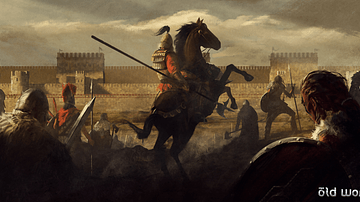
City Under Siege
Artist's impression of an army in front of a large city wall, most likely during Late Antiquity or the early Middle Ages. While this does not depict any specific event, the walls may represent the Theodosian Walls of Constantinople...

Definition
Second Crusade
The Second Crusade (1147-1149) was a military campaign organised by the Pope and European nobles to recapture the city of Edessa in Mesopotamia which had fallen in 1144 to the Muslim Seljuk Turks. Despite an army of 60,000 and...

Definition
Emperor Zeno
Zeno was Byzantine emperor from 474 until 491 CE. An ethnic Isaurian, Zeno was repeatedly criticized as an outsider during his reign, which was full of rebellions and attacks by the Ostrogoths. He is best known for his failed attempt...

Definition
Anastasios I
Anastasios I ruled the Byzantine empire from 491 to 518 CE. Although his tax and monetary reforms were both popular and successful, the emperor could not repair the damaging split in the Christian Church created by his predecessors...

Definition
Manuel I Komnenos
Manuel I Komnenos was emperor of the Byzantine Empire from 1143 to 1180 CE. Manuel continued the ambitious campaigns of his grandfather Alexios I and father John II to aggressively expand the boundaries of his empire. Manuel...
Article
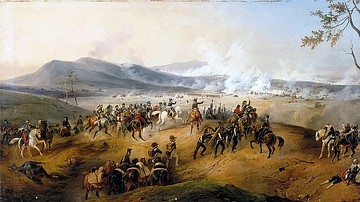
Battle of Castiglione
The Battle of Castiglione (5 August 1796) was one of the most important battles of Napoleon's Italian Campaign of 1796-97. After laying siege to the vital fortress of Mantua, General Napoleon Bonaparte and his Army of Italy...
Image
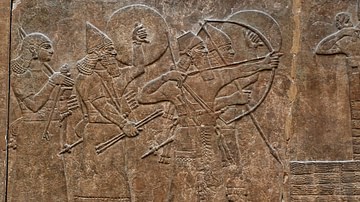
Assyrian Siege
This Assyrian relief from the North-West Palace in Kalhu (c. 865-860 BCE) shows King Ashurnasirpal advancing on an enemy city, protected by a shield-bearer. Ahead is a wheeled siege engine, which carries more archers and contains...

Definition
Michael IV the Paphlagonian
Michael IV the Paphlagonian was Byzantine emperor from 1034 to 1041 CE. He had an affair with Empress Zoe, then married her and was crowned emperor after the death of her first husband, Romanos III. He ran a competent...

Definition
Leo V the Armenian
Leo the V the Armenian was emperor of the Byzantine Empire from 813 to 820 CE. He was of Armenian descent and the last ruler of the Isaurian dynasty which had been founded by Leo III (r. 717-741 CE). The emperor's reign, after...

Article
Byzantine Icons
Icons, that is images of holy persons, were an important part of the Byzantine Christian Church from the 3rd century CE onwards. Venerated in churches, public places, and private homes, they were often believed to have protective...
