
Search
Did you mean: Tiberius?
Remove Ads
Advertisement
Search Results

Article
Graf Zeppelin's Round the World Trip of 1929
The Graf Zeppelin was the most successful of all Zeppelin airships, making several hundred trips across the Atlantic between Europe and the Americas. In 1929, a new age of air travel dawned when the Graf...

Article
Dolmens of Ancient Korea
Dolmens (in Korean: koindol or chisongmyo) are simple structures made of monolithic stones erected during the late Neolithic period or Korean Bronze Age (1st millennium BCE). In ancient Korea they appear most often near...

Article
The Grand Embassy of Peter the Great
The Grand Embassy was the name given to the long Western European tour that Tsar Peter I of Russia (aka Peter the Great, r. 1682-1725) undertook during 1697-1698. Peter was joined by hundreds of people, including...

Article
Scythian Territorial Expanse
With 7600 perimeter miles (12,231 km), the Scythians roamed and ruled over an astonishing 1.5 million mi² (2.4 million km²) of territory between the 7th and 3rd centuries BCE. Although building an empire was never in...

Article
Ancient History Encyclopedia in Japan
The “Ancient Japan” initiative at Ancient History Encyclopedia arose as there is a dearth of open access and digitally curated information concerning early Japanese history available online and in English. East...

Image
Map of the Russian Empire on the Eve of World War I, 1914 - A Eurasian Giant at the Brink
The Russian Empire on the eve of World War I (1914) represented the largest contiguous empire in modern history, stretching from Eastern Europe across Siberia to the Pacific...

Image
Map of European Expansion and Global Trade Empires, c.1700
By the 18th century, European power had become truly global through a combination of maritime expansion, state-backed commerce, and military force. The leading Atlantic empires, Spain, Portugal...

Image
Young Woolly Mammoth Carcass
This carcass of a young woolly mammoth, nicknamed 'Yuka', is on display in Moscow after being found in an astonishingly good condition in Siberia. It died around 39,000 years ago and was between 6 and 11 years old.
Image
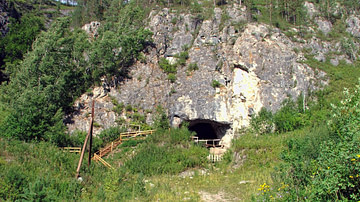
Denisova Cave
Denisova Cave in the Altai Mountains in Siberia, Russia. It is well known for human occupation stretching back as far as 280,000 years ago and shows signs of occupation by Neanderthals, Homo sapiens and Denisovans. All currently...
Image
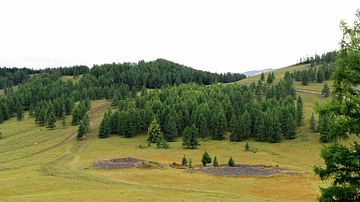
Pazyryk Kurgans
The Pazyryk burials are a series of Iron Age Scythian tombs in the Ukok Plateau, Siberia. The tombs are dated to between the 4th and 3rd Century BCE.
