
Search
Did you mean: Selene?
Remove Ads
Advertisement
Search Results

Definition
Horus
Horus is the name of a sky god in ancient Egyptian mythology which designates primarily two deities: Horus the Elder (or Horus the Great), the last born of the first five original gods, and Horus the Younger, the son of Osiris and Isis...

Definition
Yang Zhu
Yang Zhu (l. 440-360 BCE, also known as Yang Chou or Yang Chu) was a hedonist philosopher who lived and wrote during The Warring States Period in China. Little is known of his life but his work survived through the writings of the great...

Definition
Symposium - The Drinking Party of Ancient Greece
The symposium (or symposion) was an important part of ancient Greek culture from the 7th century BCE and was a party held in a private home where Greek males gathered to drink, eat and sing together. Various...

Definition
Ardashir I
Ardashir I (l. c. 180-241 CE, r. 224-240 CE) was the founder of the Persian Sassanian Empire (224-651 CE) and father of the great Sassanian king Shapur I (r. 240-270 CE). He is also known as Ardashir I Babakan, Ardeshir I, Ardashir...

Definition
Epaminondas
Epaminondas (or Epameinondas, c. 420 - 362 BCE) was a Theban general who famously defeated Sparta at the Battle of Leuctra in 371 BCE. The daring and brilliant pre-meditated tactics of Epaminondas earned a decisive victory over Sparta...

Definition
Minerva
Minerva was the Roman goddess of wisdom, medicine, commerce, handicrafts, poetry, the arts in general, and later, war. In many ways similar to the Greek goddess Athena, she had important temples in Rome and was patron of the Quinquatras...

Definition
Cato the Younger
Marcus Porcius Cato (95-46 BCE), better known as Cato the Younger or Cato of Utica, was an influential politician of the Roman Republic. As the great-grandson of Cato the Elder and a dedicated student of Stoicism, he believed...

Definition
Sargonid Dynasty
The Sargonid Dynasty was the last ruling house of the Neo-Assyrian Empire from 722-612 BCE, beginning with the reign of Sargon II and ending with fall of the Neo-Assyrian Empire. Some of the most famous kings in the history of...
Definition
Slavs
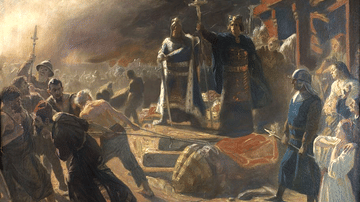
The term "Slavs" designates an ethnic group of people who share a long-term cultural continuity and who speak a set of related languages known as the Slavic languages (all of which belong to the Indo-European language family). Little...
Definition
Serapis
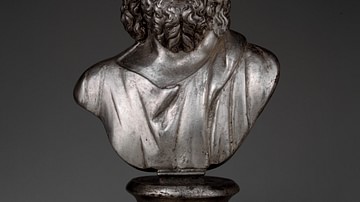
Serapis is a Graeco-Egyptian god of the Ptolemaic Period (323-30 BCE) of Egypt developed by the monarch Ptolemy I Soter (r. 305-282 BCE) as part of his vision to unite his Egyptian and Greek subjects. Serapis’ cult later spread throughout...
