
Search
Remove Ads
Advertisement
Search Results

Article
Interview with Gordon Campbell
In this interview, World History Encyclopedia talks to author and scholar Gordon Campbell all about his new book Norse America: The Story of a Founding Myth published by Oxford University Press. Kelly (WHE): Thanks...

Article
The Vikings in Ireland
In early Medieval Europe, a prime subject of frightening tales-come-true were the famously marauding and pillaging Vikings, spilling out of their dragon-headed longships in a state of bloodlust, thirsting for gold. With their...

Article
Scythian Territorial Expanse
With 7600 perimeter miles (12,231 km), the Scythians roamed and ruled over an astonishing 1.5 million mi² (2.4 million km²) of territory between the 7th and 3rd centuries BCE. Although building an empire was never in...

Article
The Causes of WWII
The origins of the Second World War (1939-45) may be traced back to the harsh peace settlement of the First World War (1914-18) and the economic crisis of the 1930s, while more immediate causes were the aggressive invasions...

Article
The Celtic Invasion of Greece
Between the 5th and 4th centuries BCE, Celtic tribes moved en masse into southern Europe, intent on seizing land and wealth to feed their swelling numbers. As these tribes began crossing the Alps, they came into conflict...

Article
The Punic Necropolis of Mahdia
The Punic funerary remains of Mahdia, a series of tombs carved into the rock, date back to a period between the 5th and the 2nd century BCE and are located in the northeast of Tunisia. These tombs are useful for us...
Article
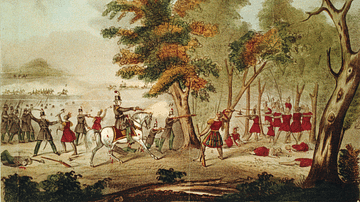
Battle of the Thames
The Battle of the Thames (5 October 1813), or the Battle of Moraviantown, was a decisive engagement in the War of 1812, in which a US army under General William Henry Harrison defeated a British and Native American force in...

Definition
Ship Money - The Unpopular Tax
Ship Money was a tax applied by medieval monarchs to English coastal communities to pay for ships for the Royal Navy and so ward off pirates and enemies of the state. During the reign of Charles I of England (r. 1625-1649...

Definition
Amos
Amos is listed as one of the twelve minor prophets in the Hebrew Bible. Amos was one of the first to put his visions into writing. The earthquake mentioned in the first chapter of the Book of Amos places Amos between 760-755 BCE. The...

Definition
Paul Cézanne
Paul Cézanne (1839-1906) was a French post-impressionist artist. Although he struggled for recognition in his own lifetime and often lacked confidence in his work, the artist's unique style, use of light and colour, and his interest...
