
Search
Remove Ads
Advertisement
Search Results

Definition
Alcibiades
Alcibiades (or Alkibiades) was a gifted and flamboyant Athenian statesman and general whose shifting of sides during the Peloponnesian War in the 5th century BCE earned him a reputation for cunning and treachery. Good-looking and...

Definition
Operation Chastise - WWII's Dambuster Raid
Operation Chastise, the 'Dambusters' raid, was an attack by a squadron of RAF Lancaster bombers on the dams of the Ruhr basin in Germany in May 1943. Led by Squadron Leader Guy Gibson, the bombers breached...
Definition
Kaskians
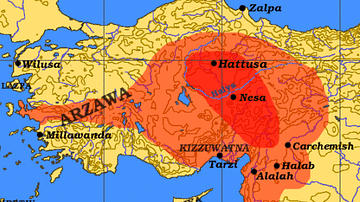
The Kaska or Kaskians were a tribe of the Pontus, northern Anatolia (today's Turkey), around the Kizil Irmak river mouth, bordering on and constantly harrasing the Hittite empire. That area is mostly mountainous in nature, and there...

Definition
Messerschmitt Bf 109
The Messerschmitt Bf 109, also known as the Me 109, was Germany's most important single-seater fighter plane throughout the Second World War (1939-45). Produced in greater numbers than any other German plane, the fighter was...

Definition
Château de Chenonceau
The Château de Chenonceau, picturesquely located astride the river Cher, in the Loire Valley town of Chenonceaux, France is a magnificent Renaissance-style building also known as le "Château des Dames" (the Ladies' Castle...

Definition
Battle of the Little Bighorn
The Battle of the Little Bighorn (25-26 June 1876) is the most famous engagement of the Great Sioux War (1876-1877). Five companies of the 7th Cavalry under Lt. Colonel George Armstrong Custer (l. 1839-1876) were wiped...

Definition
Agrippina the Elder - Daughter of the Caesars
Agrippina the Elder (14 BCE to 33 CE), as the granddaughter of Emperor Augustus and the wife of the popular general Germanicus, wielded significant influence in the early years of the Roman Empire and was...

Definition
Louis I de Bourbon, Prince of Condé
Louis I de Bourbon (l. 1530-1569) was a descendant of Louis IX of France (r. 1226-1270) and founder of the House of Condé. The Prince of Condé proved his valor as a Huguenot military leader during the first three...

Definition
Ancient Greece
Greece is a country in southeastern Europe, known in Greek as Hellas or Ellada, and consisting of a mainland and an archipelago of islands. Ancient Greece is the birthplace of Western philosophy (Socrates, Plato, and Aristotle...

Definition
D-Day
D-Day was the first day of Operation Overlord, the Allied attack on German-occupied Western Europe, which began on the beaches of Normandy, France, on 6 June 1944. Primarily US, British, and Canadian troops, with naval and air support...
