
Search
Did you mean: Silenus?
Remove Ads
Advertisement
Search Results

Definition
Aria
Aria (or Areia) was always understood to be the area around the Areios River, today Hari Rud in Afghanistan (Arrian, Anabasis IV.6.6). It was bounded to the north by Margiana and Bactria, where the area of the Margos River begins; to the...

Image
Map of the Hellenistic Kingdoms after Alexander, c.301 BCE
The Hellenistic Successor Kingdoms (the Diadochi, from the Greek for “Successors”) emerged after the death of Alexander the Great in 323 BCE, when his vast empire fractured among his generals. From this division arose powerful states such...

Image
Map of the Successor Kingdoms, c. 303 BCE
Map of the Diadochi successor kingdoms to Alexander the Great's empire, before the Battle of Ipsus (301 BCE).
Image
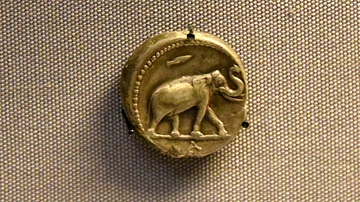
Seleucid Silver Tetradrachm Depicting an Elephant
This silver tetradrachm coin belonged to Seleucos I. It depicts a striding elephant. Reign of Seleucos I Nicator, 305-281 BCE. Minted in modern-day Iran. Donated by Richard Payne Knight. (The British Museum, London).
Image
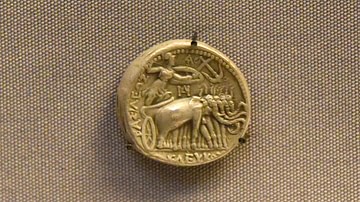
Tetradrachm Coin from Seleucid Syria
This is a silver tetradrachm coin. Reign of Seleucos I Nicator, 305-281 BCE. From Seleucid Syria. Donated by the Bank of England. (The British Museum, London).

Article
Ten Ancient Persia Facts You Need to Know
Ancient Persian culture exerted a powerful influence throughout the Near East, and beyond, for over a thousand years between c. 550 BCE - 651 CE and many aspects of their culture continued to influence others afterwards and up through the...

Article
Achaemenid Kings List & Commentary
The Achaemenid Empire (c. 550-330 BCE) was the first great Persian political entity in Western and Central Asia which stretched, at its peak, from Asia Minor to the Indus Valley and Mesopotamia through Egypt. It was founded by Cyrus II (the...

Article
Sassanian Kings List & Commentary
The Sassanian Empire (224-651) was the greatest expression of Persian culture in the ancient world. It was consciously modeled on the earlier Achaemenid Empire (c. 550-330 BCE) which established Persian supremacy in the region and developed...

Article
Polybius' Capture of Achaeus and Fall of Sardis
Polybius' Capture of Achaeus and Fall of Sardis is the account of the end of the Siege of Sardis (215-213 BCE) by Antiochus III (aka Antiochus the Great, r. 223-187 BCE) of the Seleucid Empire after the betrayal and capture of his cousin...

Image
Rules for playing the Royal Game of Ur
There are Akkadian cuneiform inscriptions as well as explanatory diagram and rules for playing the so-called the game of 20-squares (the Royal Game of Ur).This is the front aspect of the clay tablet which shows how the central squares were...
