
Search
Remove Ads
Advertisement
Search Results

Article
The Lamentations of Isis and Nephthys
The Lamentations of Isis and Nephthys is an ancient Egyptian text in which the two goddess-sisters call the soul of the god Osiris to rejoin the living. The poem takes the form of a call-and-response liturgy and...

Article
Mulan: The Legend Through History
Mulan (“magnolia”) is a legendary character in Chinese literature who is best known in the modern day from the Disney filmed adaptations (1998, 2020). Her story, however, about a young girl who takes her father's...

Article
Herodotus on the Egyptians
II:35. The Egyptians in agreement with their climate, which is unlike any other, and with the river, which shows a nature different from all other rivers, established for themselves manners and customs in a way opposite...

Article
Great Female Rulers of Ancient Egypt
Women in ancient Egypt had more rights than in any other ancient culture and were valued with greater respect. This is evident not only in the physical evidence and inscriptions but in their religion. Some of the...
Image
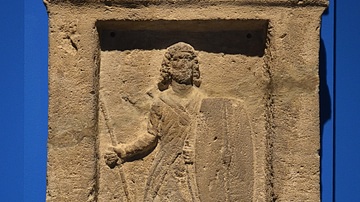
Bosporan Soldier
Grave stele of Staphilos, son of Glaukias, from the Bosporan Kingdom. It depicts a soldier with the traditional Bosporan long hair and beard, and Scythian costume. It dates to the 2nd century CE and comes from the Necropolis of...

Image
Map of the Bosporan Kingdom, c.100 CE - Gateway Between Steppe, Caucasus, and Rome
The Bosporan Kingdom (c. 480 BCE–341 CE) emerged around the Cimmerian Bosporus (modern Kerch Strait) as a hybrid Greco-local state founded by Greek colonists from cities such...

Video
History of the Scythians: an Ancient Nomadic Culture
The Scythians were a nomadic culture that flourished between the seventh and the third centuries BCE, as their territory expanded from Thrace in the west across the Central Asian Steppe (a steppe is...
Image
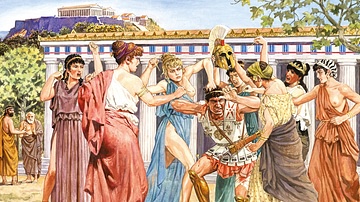
Athenian Women Attack a Messenger
Athenian women attacking the messenger who brings news that their husbands' died in battle. Illustration by Marek Szyszko.
Image
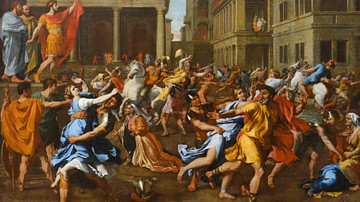
The Rape of the Sabine Women
The Rape of the Sabine Women, painting by Nicolas Poussin, 1637-1638 CE.
Louvre, Paris
Photo credit: Francisco Anzola
Image
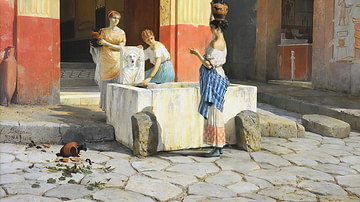
Women at a Well in Pompeii
Illustration of what life may have looked like in ancient Pompeii. "Women at the Well" by Luigi Bazzani (1836-1927), oil on woodpanel.
