
Search
Remove Ads
Advertisement
Search Results
Image
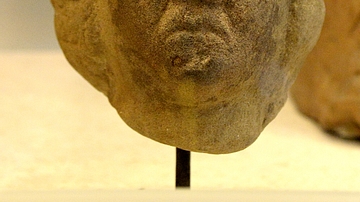
Head of a Local Deity, Birrens, Scotland
In the Roman empire deities which were not part of normal Roman beliefs were often readily adopted and worshiped. On the frontiers, such as Scotland, soldiers worshiped local gods and goddesses. This is a head...
Image
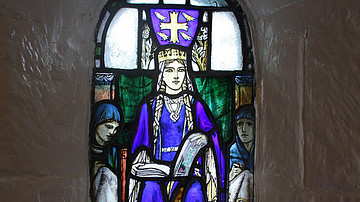
Saint Margaret of Scotland Stained Glass Window
A stained glass window showing Saint Margaret of Scotland, from her chapel in Edinburgh Castle. Queen Margaret (c. 1046-1093 CE) was the wife of Malcolm III of Scotland (r. 1058-1093 CE) from 1070 CE to...
Image
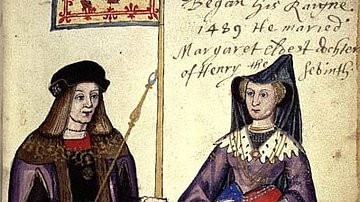
James IV of Scotland & Margaret Tudor
A 1591 manuscript illustration showing James IV of Scotland (r. 1488-1513) and Margaret Tudor (1489-1541). Seton Armorial.
National Library of Scotland, Edinburgh.

Image
James II of Scotland and Mary of Guelders
James II of Scotland (r. 1437-1460) and Mary of Guelders (d. 1463), whose marriage in 1449 strengthened the ties between Scotland and Flanders.
Image
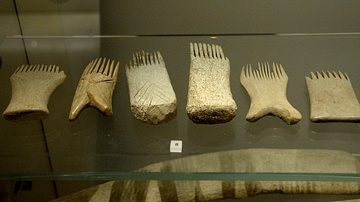
Weaving Combs from Ancient Scotland
These combs were made of whalebone. What makes whalebone particularly useful is not only is it strong, dense, and resilient, but it can also be used to produce objects of very large sizes. This collection of weaving...

Image
James III of Scotland & Margaret of Denmark
A 16th century CE manuscript illustration showing James III of Scotland (r. 1460-1488 CE) and Queen Margaret (d. 1486 CE). From the Froman Armorial. (National Library of Scotland, Edinburgh).

Image
James IV of Scotland Kneeling in Prayer
A c. 1502 parchment illustration showing James IV of Scotland (r. 1488 to 1513 CE) kneeling in prayer to an altarpiece. Behind him is Saint James. (Hours of James IV of Scotland, Austrian National Library, Vienna...

Image
Portrait of James III of Scotland
A 17th century CE portrait of James III of Scotland (r. 1460-1488 CE). (National Galleries of Scotland, Edinburgh)
Image
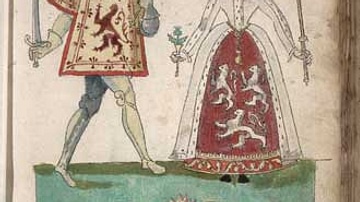
Robert II of Scotland & Queen Euphemia
A 16th-century manuscript illustration showing Robert II of Scotland (r. 1371-1390) and his second wife Euphemia, Countess of Moray. From the Froman Armorial.
National Library of Scotland, Edinburgh.
Image
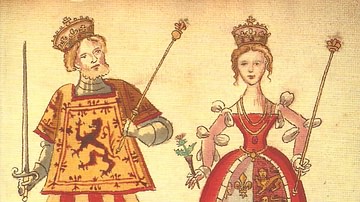
James I of Scotland & Queen Joan
A 16th century CE manuscript illustration showing James I of Scotland (r. 1406-1437 CE) and Queen Joan Beaufort. From the Froman Armorial. (National Library of Scotland, Edinburgh).
