
Search
Remove Ads
Advertisement
Search Results

Article
The Newly Discovered Tablet II of the Epic of Gilgamesh
Surpassing all other kings, heroic in stature, brave scion of Uruk, wild bull on the rampage! Going at the fore he was the vanguard, going at the rear, one his comrades could trust...

Article
The Lullubian Rock Relief of Darband-i Basara
History doesn't repeat itself, but it does rhyme. (Mark Twain) Darband-i Basara (the Pass of Basara) is a narrow natural gorge which transects the anticlines of the upper part of the Qaradagh Mountain...
Image
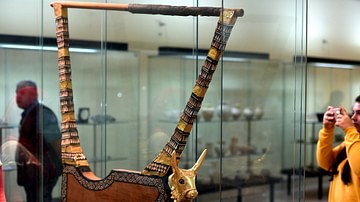
The Golden Lyre of Ur at the Iraq Museum
This is the finest among all lyres found at the Royal Cemetry at Ur and was given to the Iraq Museum; the other lyres were divided between the British Museum in the UK and the Penn Museum in the USA. The head...

Image
The Bassetki Statue at the Iraq Museum
This statue weighs about 150 Kg and is made of pure copper, a more difficult casting that requires a much higher temperature than that of bronze. The diameter of the rounded pedestal is about 67 cm and the height...
Image
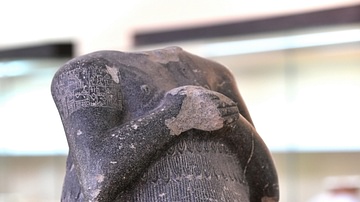
Headless Statue of Entemena of Lagash
This black diorite statue depictes Entemena, a king (or ruler) of Lagash, around 2400 BCE; identified by the cuneiform inscriptions on the right shoulder and back. The king wears the typical flounced Sumerian...
Image
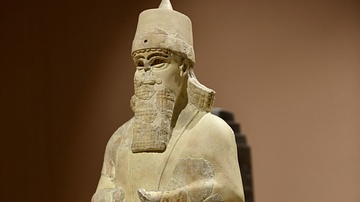
Statue of Shalmaneser III from Nimrud
This statue represents Shalmaneser III (reigned 858-824 BCE) and was found by a peasant accidentally in the early spring of 1956. It was badly fragmented at the south-east corner of Nimrud city wall, at the foot...
Image
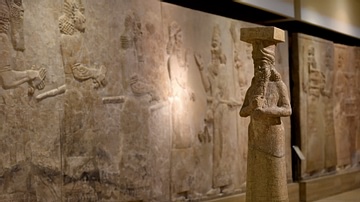
Statue of a Minor Deity & Tributary Scenes Khorsabad
On the right, a statue of a minor deity (probably Ea) stands and holds a vessel in his hands, from which water flows. It is one of a pair of statues which were found outside the entrance (in front...
Image
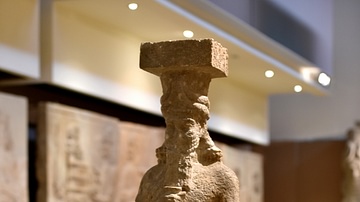
Statue of a Minor Deity from Khorsabad
This statue of a minor deity (probably Ea, god of water and sea) stands and holds a vessel in his hands, from which water flows. It is one of a pair of statues which were found outside the entrance (in front...

Video
Why Do We Have Museums
Museums have been a part of human history for over 2,000 years — but they weren't always like the ones we visit today. J. V. Maranto uncovers the evolution of museums, from the first museum in 530 BCE (curated by a princess...
