
Search
Did you mean: Bes?
Remove Ads
Advertisement
Search Results

Article
The Brink's-Mat Robbery - Britain's Biggest Bullion Heist
Six armed robbers. One warehouse. Three tons of gold worth around $320 million today. The raid on the Brink's-Mat secure storage facility on the edge of London's Heathrow airport on 26 November...

Article
Mark Antony's Oration at Caesar's Funeral
Amid the chaos and strife following the assassination of Julius Caesar in 44 BCE, Mark Antony (83-30 BCE), with the advice of Cicero, persuaded the Roman Senate to declare an amnesty which pardoned the Liberators...
Article
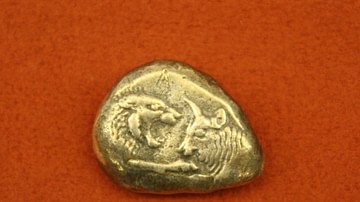
The Importance of the Lydian Stater as the World's First Coin
The Lydian Stater was the official coin of the Lydian Empire, introduced before the kingdom fell to the Persian Empire. The earliest staters are believed to date to around the second half of...

Article
William Harvey's Discovery of Blood Circulation
The human body's system of blood circulation was discovered by the English physician and anatomist William Harvey (1578-1657) in 1628. Harvey determined the relationship between the blood system of arteries...

Article
Hitler's Occupation of Czechoslovakia
Throughout 1938, Adolf Hitler (1889-1945), the leader of Nazi Germany, threatened to occupy the Sudetenland region of Czechoslovakia. The excuse presented was that Sudeten Germans were being repressed but Hitler...

Article
The Women of Athena's Cult
In ancient Athens, women had no life outside the home unless they were prostitutes or were engaged in religious activities such as festivals. Every Greek deity in every city-state had their own cult (sect) but the cult...

Article
Martin Luther's 95 Theses
Martin Luther's 95 Theses of 31 October 1517, although they have since come to represent the beginning of the Protestant Reformation, were not written to challenge the authority of the Roman Catholic Church but were simply...

Article
Lenin's New Economic Policy - Communism's Flirtation with Capitalism
The New Economic Policy (NEP) of Vladimir Lenin (1870-1924), leader of Soviet Russia, was the introduction in 1921 of a limited form of capitalism in light industry and agriculture. Contrary...

Article
Gobekli Tepe - the World's First Temple?
Located in modern Turkey, Göbekli Tepe is one of the most important archaeological sites in the world. The discovery of this stunning 10,000 year old site in the 1990s CE sent shock waves through the archaeological...

Article
Eyewitness Accounts of WWII's Eastern Front
The Eastern Front (1941-5), called the Western Front or Great Patriotic War by the Soviets, was by far the bloodiest of the Second World War (1939-45). In this article, the memories of those who experienced...
