
Search
Remove Ads
Advertisement
Search Results
Image
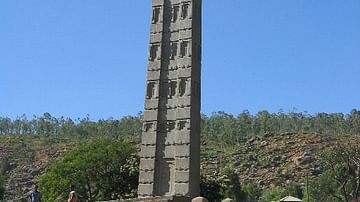
Royal Obelisk, Axum
A stone monolithic obelisk marking the tomb of King Ezanas of the kingdom of Axum (aka Aksum, modern Ethiopia), c. 400 CE. The carvings imitate the architectural features of dry-stone and timber housing.

Image
Achaemenid Royal Tombs
Tombs of the Achaemenid kings of Darius I, Xerxes I and Artaxerxes I at Naqsh-e Rostam.
Image
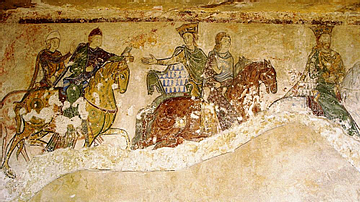
Royal Hunt Fresco, Chapelle Sainte-Radegonde
A fresco from the Chapelle Sainte-Radegonde, thought to depict Henry II of England (1154 - 1189 CE), Eleanor of Aquitane (r. 1137 - 1204 CE), and their children. The fresco may also depict Henry the Young...
Image
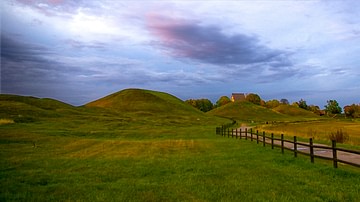
Gamla Uppsala, Royal Mounds
Burial mounds at Gamla Uppsala, Sweden. Legend has it that three Norse gods - Odin, Thor, and Freyr - were buried under each and the site where the Temple of Uppsala once stood was sacred to them. Excavations of the mounds...
Image
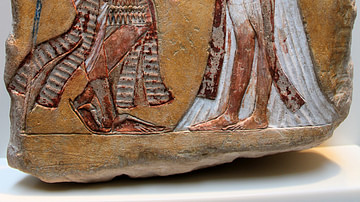
Royal Couple
Painted limestone relief, possibly depicting Akhenaten and Nefertiti, from Amarna, 18th Dynasty, c. 1335 BCE.
Neues Museum, Berlin.

Definition
Mycenaean Civilization
The Mycenaean civilization flourished in the Late Bronze Age (c. 1700-1100 BCE), peaking from the 15th to the 13th century BCE. The Mycenaeans extended their influence throughout the Peloponnese in Greece and across the Aegean...

Article
The Origins of British Pub Names
Pubs remain a prominent feature of the rural and urban landscapes of Britain, but their names very often date back to medieval times. Red lions, white horses, and colourful characters peer from pub signs as landlords...

Definition
Thomas Wolsey
Thomas Wolsey, Cardinal Archbishop of York (l. c. 1473-1530 CE) served as Lord Chancellor to Henry VIII of England (r. 1509-1547 CE) from around 1513 CE to 1529 CE. Wolsey rose to become the most powerful man in England after the...

Definition
Charles I of England
Charles I of England (r. 1625-1649) was a Stuart king who, like his father James I of England (r. 1603-1625), viewed himself as a monarch with absolute power and a divine right to rule. His lack of compromise with Parliament...

Definition
Edmund Burke
Edmund Burke (1729-1797) was an Anglo-Irish statesman and political thinker. His most famous work is Reflections on the Revolution in France a critique of the social and political turmoil in that country in the final decade of the...
