
Search
Did you mean: Roman Roads?
Remove Ads
Advertisement
Search Results

Definition
Amphitheatre - The Roman Contribution to Public Architecture
An amphitheatre was a structure built throughout the Roman empire where ordinary people could watch such spectacles as gladiator games, mock naval battles, wild animal hunts, and public executions...

Article
The Battle at the Allia River, 390 BCE
The 390 BCE battle at the Allia River was fought between the city state of Rome and Gauls from northern Italy. When the Gauls laid siege to the Etruscan city of Clusium, the Romans intervened on behalf of the...

Article
The Principate of Augustus
Augustus (r. 27 BCE to 14 CE), as the adopted son and heir of Julius Caesar (100-44 BCE), brought an end to the Roman Republic, and on 16 January 27 BCE, by Senatorial decree, he became the first Roman emperor. However...

Image
The Five Good Emperors of the Roman Empire (96 - 180 CE)
This infographic illustrates the succession of Roman emperors from 96 to 180 CE, commonly referred to as the Five Good Emperors - Nerva, Trajan, Hadrian, Antoninus Pius, and Marcus Aurelius. This...

Video
Eros-Cupid and Psyche, the Greek and Roman Gods of Love and the Soul
Eros in Greek mythology, known as Cupid in Rome, is the god of love but more specifically, the god of physical and passionate desire. He is often referred to as a son and attendant of...

Image
Roman Blue-Glass Cinerary Urn from Luguvalium
Roman blue-glass cinerary urn, from Luguvalium (Botchergate, Carlisle), 1st century CE. Carlisle Cathedral. Burning the body after death and keeping the bones and ashes in the cineraria (funerary urns...

Video
The Roman Epic Poem The Aeneid: Introduction and Summary
The Aeneid was written by the Roman poet Virgil who lived between 70 and 19 BCE during the Augustan Period (named for Augustus, the first emperor of Rome). The twelve-book long epic poem tells the...
Image
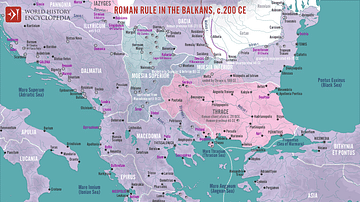
Roman Rule in the Balkans, c. 200 CE
A map illustrating Roman rule in the Balkans around 200 CE, characterized by significant administrative, military, and cultural integration into the Empire. The region was divided into several provinces (Moesia...

Article
The Journeys of Paul the Apostle
The journeys of Paul the Apostle, as the New Testament relates in the Book of Acts, started with his conversion experience on the way to Damascus, after which instead of seeking to thwart the growing Christian movement...

Definition
Kosrau I
Kosrau I (r. 531-579 CE) was the greatest king of the Sassanian Empire (224-651 CE) in virtually every aspect of his reign. He reformed the military, the Persian government, expanded his territories, engaged in large-scale building...
