
Search
Remove Ads
Advertisement
Search Results

Article
Cultural Links between India & the Greco-Roman World
Cyrus the Great (558-530 BCE) built the first universal empire, stretching from Greece to the Indus River. This was the famous Achaemenid Empire of Persia. An inscription at Naqsh-i-Rustam, the tomb of his able successor Darius I (521-486...
Article
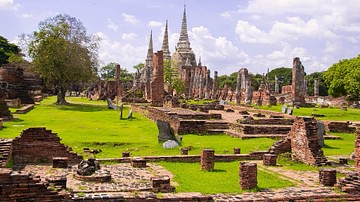
Ayutthaya: Venice of the East
The royal city of Ayutthaya (ah-you-tah-ya) was a small kingdom in Siam (modern Thailand), and it was an unrivalled commercial and maritime power from 1350-1767 CE. Ayutthaya became the second capital of Siam in 1438 CE when it absorbed the...

Article
The Ajanta Caves
The 30 caves at Ajanta lie to the north of Aurangabad in the Indhyadri range of Western Ghats. The caves, famous for their temple architecture and many delicately drawn murals, are located in a 76 m high, horseshoe-shaped escarpment overlooking...

Definition
Lumbini
Lumbini is a village, archaeological site, and place of pilgrimage honored as the birthplace of Siddhartha Gautama (the Buddha, l. c. 563-483 BCE) located in modern-day Rupandehi District of Nepal, Province 5, near the Indian border. It was...

Definition
Gandhara Civilization
The Gandhara Civilization existed in what is now Northern Pakistan and Afghanistan from the middle of the 1st millennium BCE to the beginning of the 2nd millennium CE. Although multiple major powers ruled over this area during that time...

Definition
Four Noble Truths
The Four Noble Truths are the foundational tenets of Buddhism, which spark awareness of suffering as the nature of existence, its cause, and how to live without it. The truths are understood as the realization which led to the enlightenment...

Article
Ten Great Stupas from Around the World
A stupa is a reliquary containing the remains (relics) of an individual associated with great spiritual power and insight, most often (since the 3rd century BCE) with the Buddha (l. c. 563 - c. 483 BCE). The form, a hemisphere topped by a...

Interview
Interview: Bejeweled Sri Lanka
The first comprehensive survey of Sri Lankan art organized by an American museum, The Jeweled Isle: Art from Sri Lanka, on show now at the LACMA in Los Angeles, California, presents some 250 works addressing nearly two millennia of Sri Lankan...

Definition
Siddhartha Gautama
Siddhartha Gautama (better known as the Buddha, l. c. 563 - c. 483 BCE) was, according to legend, a Hindu prince who renounced his position and wealth to seek enlightenment as a spiritual ascetic, attained his goal and, in preaching his path...
Article
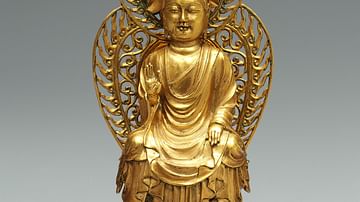
Buddhism in Ancient Korea
Buddhism, in Korean Bulgyo, was introduced by monks who visited and studied in China and then brought back various Buddhist sects during the Three Kingdoms period. It became the official state religion in all Three Kingdoms and subsequent...
