
Search
Remove Ads
Advertisement
Search Results

Image
The Emerald Buddha in Seasonal Costumes
The Emerald Buddha adorned with three seasons regalia. From left to right: Summer, Rainy, Winter. The Emerald Buddha is located in Wat Phra Kaew in Bangkok, Thailand and was built in 1784 CE.
Image
Buddha Image, Ayutthaya
Buddha image in the Wat Na Phra Meru in Ayutthaya, Thailand. The Buddha is seated in the 'subduing Mara' position and wears royal attire. Photo taken in 2019 CE.
Image
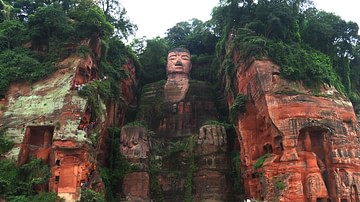
Leshan Giant Buddha
Construction of the famous Leshan Giant Buddha, an enormous statue of a Maitreya (a future Buddha) was started in 713 CE under Xuanzong's reign. A Buddhist monk named Hai Tong began the project to ward off evil spirits from the river at the...
Image
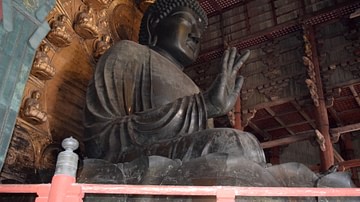
Buddha, Todaiji
The huge bronze Buddha in the Daibutsuden or Great Buddha Hall at the Todaiji temple complex, Nara, Japan. c. 752 CE, Nara Period. Height: 15 metres (49 ft.). Partially restored with the legs and lower body being wholly original.

Definition
Seokguram Grotto
The Seokguram Grotto (Sokkuram) is a Buddhist cave temple constructed during the Unified Silla Period (668-935 CE) of ancient Korea. The 8th-century CE structure, located near the Bulguksa Temple on Mt. Toham at the ancient Silla capital...

Definition
Tara
Tara is a female deity in both Hinduism and Buddhism who personifies compassion and offers salvation from the suffering of rebirth and death. She is thought to have been born of empathy for the suffering world and is regularly invoked for...

Definition
Ancient Nara
Nara, located around 30 km south of modern Kyoto, was the capital of ancient Japan between 710 and 784 CE. It gave its name to the Nara Period (710-794 CE), although the name during the 8th century CE was Heijokyo. Modelled on the Chinese...
Definition
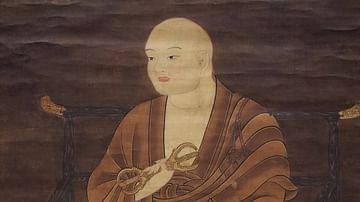
Kukai - Japan's Founder of Shingon Buddhism
Kukai or Kobo Daishi (774-835 CE) was a scholar, poet, and monk who founded Shingon Buddhism in Japan. The monk became the country's most important Buddhist saint and has been credited with all manner of minor miracles. Noted as a gifted...
Image
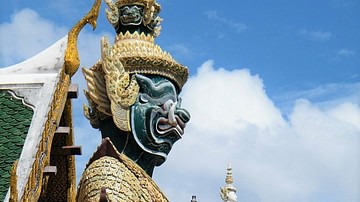
Yaksha or Demon Guardians at the Temple of the Emerald Buddha
Six pairs of giant demon guardians flank all entrances to the Temple of the Emerald Buddha in Bangkok, Thailand. They are known as yaksha or in Thai are simply called yak (giant), and they are Buddhist gods that protect against evil spirits...

Image
Seated Buddha from Gandhara
This Seated Buddha was found in Gandhara, Pakistan (100-300 CE).
This image was taken at the National Museum of Australia in the travelling exhibition A History of the World in 100 (and 1) Objects.
