
Search
Remove Ads
Advertisement
Search Results

Definition
Seshat
Seshat (also given as Sefkhet-Abwy and Seshet) is the Egyptian goddess of the written word. Her name literally means "female scribe" and she is regularly depicted as a woman wearing a leopard skin draped over her robe with a headdress...

Definition
Ancient Egyptian Vizier
The vizier in ancient Egypt was the most powerful position after that of king. Known as the djat, tjat, or tjati in ancient Egyptian, a vizier was the equivalent of the modern-day prime minister of the nation who actually...

Definition
Djed
The djed is an ancient Egyptian symbol for stability which features prominently in Egyptian art and architecture throughout the country's history. `Stability' should be understood to mean not only a firm footing but immutability and permanance...

Video
Egypt: New Kingdom
This video summarises the main events and developments of Egypt's New Kingdom.
Image
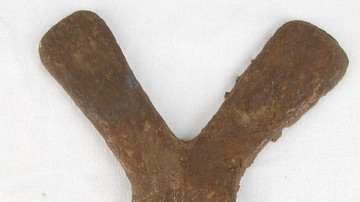
Copper Curency Ingot, Luba Kingdom
A copper cross used as a currency by such central African states as the Kingdom of Luba (15-19th century CE). Height: 19.5 cm. (British Museum, London)
Image
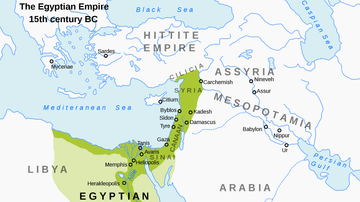
Map of the New Kingdom of Egypt, 1450 BCE
A map showing the maximum territorial extent of the New Kingdom of Egypt, ca. 1450 BCE.

Image
Horned Mask, Luba Kingdom
A wooden horned mask of the Kingdom of Luba (15-19th century CE), central Africa. Height: 47 cm. (British Museum, London)
Image
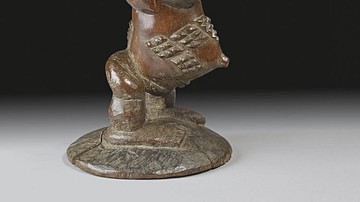
Carved Stool, Luba Kingdom
A carved wooden stool in the form of a figure from the Kingdom of Luba (15-19th century CE), central Africa. Height: 42.5 cm. (British Museum, London)
Image
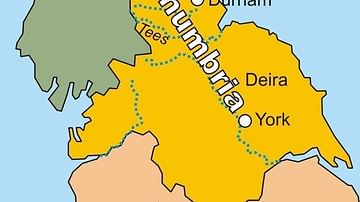
Map of the Kingdom of Northumbria
A map of the Kingdom of Northumbria (c. 604-954 CE) in the northeast of Britain c. 802 CE.

Image
Funerary Urn, Unified Silla Kingdom
A ceramic funerary urn from the Unified Silla kingdom of ancient Korea. The decoration is typical of the period and was achieved using stamps. 8th century CE. (Freer and Sackler Galleries, Washington, D.C)
