
Search
Did you mean: Mythology?
Remove Ads
Advertisement
Search Results

Definition
David Hume
David Hume (1711-1776) was a Scottish philosopher, writer, historian, and important figure in the Enlightenment. Hume presented a positive view of human nature but a sceptical view of religion's usefulness. His Treatise of Human Nature...

Definition
Flavius Josephus
Titus Flavius Josephus (36-100 CE), was born Yosef ben Matityahu and became a 1st-century CE Jewish historian. He was a member of a priestly household in Jerusalem through his father’s side (the house and order of Jehoiarib...

Definition
Galen
Galen (129-216 CE) was a Greek physician, author, and philosopher, working in Rome, who influenced both medical theory and practice until the middle of the 17th century CE. Owning a large, personal library, he wrote hundreds of medical...
Definition
Ganymede
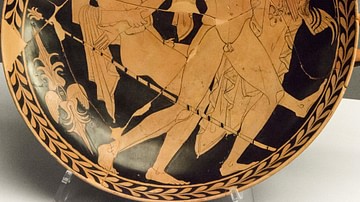
Ganymede (pronounced GAH-nuh-meed) is a youth in Greek mythology who is abducted by Zeus because of his great beauty and brought to Mount Olympus to serve as cupbearer. The story first appears in Homer’s Iliad without any suggestion...
Definition
Baruch Spinoza
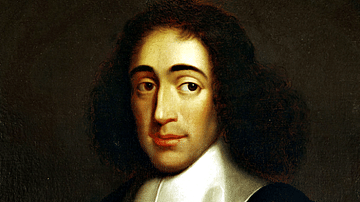
Baruch Spinoza (1632-1677) was a Dutch philosopher who combined rationalism and metaphysics to create a unique system of thought. Spinoza was held up as an atheist philosopher in the 18th century, but this is not an entirely accurate...

Definition
Antinous
Antinous (l. c. 110-130 CE) was a youth of Bithynia who became the beloved of the Roman emperor Hadrian (l. 76-138 CE, r. 117-138 CE) from around the age of 13 until his death at nearly 20. His year of birth is unknown as are any details...

Definition
John Stuart Mill
John Stuart Mill (1806-1873) was a highly influential English philosopher of the Victorian Era. His writings were influenced by the Enlightenment thinkers and German Romanticism. Besides philosophical works, he wrote on mathematics...

Definition
Hector Berlioz
Hector Berlioz (1803-1869) was the leading French composer of Romantic music, best known for his innovative Symphonie fantastique and use of large-scale orchestras and choruses in works like The Trojans opera. Berlioz's innovative...

Definition
Michael Psellos
Michael Psellos (1018 - c. 1082 CE) was a Byzantine historian, writer, and intellectual. Michael acted as courtier and advisor to several Byzantine emperors, and he was the tutor of Michael VII. Writing between 1042 and 1078 CE...

Video
History vs. Sigmund Freud - Todd Dufresne
Working in Vienna at the turn of the 20th century, he began his career as a neurologist before pioneering the discipline of psychoanalysis, and his influence towers above that of all other psychologists in...
