
Search
Did you mean: Furies?
Remove Ads
Advertisement
Search Results

Definition
The Vedas
The Vedas are the religious texts which inform the religion of Hinduism (also known as Sanatan Dharma meaning “Eternal Order” or “Eternal Path”). The term veda means “knowledge” in that they are thought to contain the fundamental knowledge...

Definition
Easter
Easter is the Christian holiday that celebrates the resurrection of Jesus of Nazareth three days after he died from crucifixion by the Roman magistrate Pontius Pilate (c. 30 CE). Easter Sunday is the culmination of the week-long events...

Definition
Roman Government
Western Civilization is forever indebted to the people of ancient Greece and Rome. Among the numerous contributions these societies made are in the fields of art, literature and philosophy; however, perhaps their greatest gift...

Definition
Pluto
Pluto is the god of the Underworld in Roman mythology. His Greek counterpart was Hades. Pluto chose never to sit on Olympus with the other gods and goddesses, preferring to remain in the Underworld. Family Pluto (Hades) was the son...

Definition
Xolotl - The Dog God of the Aztecs
Xolotl was the dog god of the Mexica people, commonly known as the Aztecs. He is represented in codices, statuary, and other extant examples of Aztec art as a dog or a god with the head of a dog. While this figure...

Definition
Taoism
Taoism (also known as Daoism) is a Chinese philosophy attributed to Lao Tzu (c. 500 BCE) which developed from the folk religion of the people primarily in the rural areas of China and became the official religion of the country under...

Definition
Silla
The Silla kingdom ruled south-eastern Korea during the Three Kingdoms period from the 1st century BCE to 7th century CE. The capital was Geumseong (Gyeongju) with a centralised government and hierarchical system of social ranks. The prosperity...
Definition
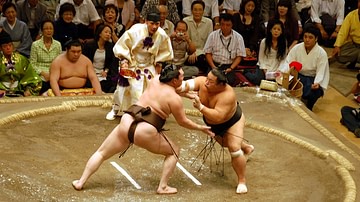
Sumo - Japan's Ancient Form of Wrestling
Sumo (Ozumo) is an ancient form of wrestling which has long been the national sport of Japan. Its origins go back to the Yayoi period (c. 300 BCE - c. 300 CE) and it incorporates many elements of the Shinto...

Definition
Book of Amos
The Book of Amos is a prophetic book of the Hebrew Bible largely dating to the 8th century BCE and considered to be scripture by modern-day Jews and Christians. The work chronicles the visions that the ancient author of this book...

Definition
King David
According to biblical tradition (and some say myth), David (c. 1035-970 BCE) was the second king in the ancient United Kingdom of Israel who helped establish the eternal throne of God. A former shepherd, David was renowned for his...
