
Search
Did you mean: Furies?
Remove Ads
Advertisement
Search Results

Definition
Artaxerxes I
Artaxerxes I (r. 465-424 BCE) was the sixth monarch of the Achaemenid Persian Empire. He was the son of Xerxes I (r. 486-465 BCE) and his principal wife Amestris (d. 424 BCE) and grandson of Darius I (the Great, r. 522-486 BCE...
Definition
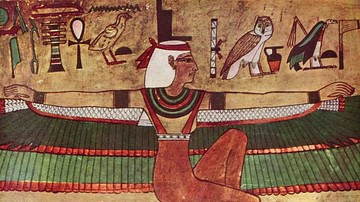
Isis
Isis is an ancient Egyptian goddess who became the most popular and enduring of all the Egyptian deities. Her name comes from the Egyptian Eset, ("the seat") which referred to her stability and also the throne of Egypt as she was considered...

Definition
Sophocles
Sophocles of Kolōnos (c. 496 - c. 406 BCE) was one of the most famous and celebrated writers of tragedy plays in ancient Greece and his surviving works, written throughout the 5th century BCE, include such classics as Oedipus Rex...

Definition
Asclepius
Asclepius was the ancient Greek god of medicine, and he was also credited with powers of prophecy. The god had several sanctuaries across Greece; the most famous was at Epidaurus which became an important centre of healing in both...

Definition
Ancient Egyptian Culture
Ancient Egyptian culture flourished between c. 6000 BCE with the rise of technology (as evidenced in the glasswork of faience) and 30 BCE with the death of Cleopatra VII, the last Ptolemaic ruler of Egypt. It is famous...

Definition
The Vedas
The Vedas are the religious texts which inform the religion of Hinduism (also known as Sanatan Dharma meaning “Eternal Order” or “Eternal Path”). The term veda means “knowledge” in that they are thought to contain the fundamental knowledge...

Definition
Easter
Easter is the Christian holiday that celebrates the resurrection of Jesus of Nazareth three days after he died from crucifixion by the Roman magistrate Pontius Pilate (c. 30 CE). Easter Sunday is the culmination of the week-long events...

Definition
Roman Government
Western Civilization is forever indebted to the people of ancient Greece and Rome. Among the numerous contributions these societies made are in the fields of art, literature and philosophy; however, perhaps their greatest gift...

Definition
Pluto
Pluto is the god of the Underworld in Roman mythology. His Greek counterpart was Hades. Pluto chose never to sit on Olympus with the other gods and goddesses, preferring to remain in the Underworld. Family Pluto (Hades) was the son...

Definition
Xolotl - The Dog God of the Aztecs
Xolotl was the dog god of the Mexica people, commonly known as the Aztecs. He is represented in codices, statuary, and other extant examples of Aztec art as a dog or a god with the head of a dog. While this figure...
