
Search
Remove Ads
Advertisement
Search Results

Article
Agriculture in the Fertile Crescent & Mesopotamia
The ancient Near East, and the historical region of the Fertile Crescent in particular, is generally seen as the birthplace of agriculture. The first agricultural evidence comes from the Levant, from...

Article
Etruscan Bronze Sculpture
The Etruscans produced bronze goods going back to the Villanovan period (1100-750 BCE) and used the material for all manner of objects, but it is their figure sculptures which have become some of the star attractions in...

Article
Ten Ancient Egypt Facts You Need to Know - Fun Trivia About Ancient Egypt
Ancient Egypt is defined as the civilization that flourished in North Africa between circa 6000 and 30 BCE – from the Predynastic Period in Egypt (circa 6000 to circa 3150 BCE) through...

Article
The Eleusinian Mysteries: The Rites of Demeter
The Rites of Eleusis, or the Eleusinian Mysteries, were the secret rituals of the mystery school of Eleusis and were observed regularly from c. 1600 BCE - 392 CE. Exactly what this mystic ritual was no...

Article
Wall Reliefs: Apkallus of the North-West Palace at Nimrud
Religion is the sigh of the oppressed creature, the heart of a heartless world, and the soul of soulless conditions. It is the opium of the people. (Karl Marx, Critique of Hegel's Philosophy of...

Article
Wine Culture in the Hellenistic Mediterranean
The culture of drinking wine was enjoyed throughout the Mediterranean world, and what is true now was true in antiquity, too: wine is always good business. The Hellenistic Period (c. 335-30 BCE), between...

Article
The Life of Crates of Thebes in Diogenes Laertius
Crates of Thebes (l. c. 360-280 BCE) was one of the most important Cynic philosophers of ancient Greece. He was born to a wealthy family in Thebes but gave away his inheritance after realizing the futility...

Image
Processional Dancer Bringing Cake Offerings
Apulian stemless cup (fragment) depicting a processional dancer bringing cake offerings, c. 350-325 BCE. The Ure Museum of Greek Archaeology, Reading. acc. no. 22.3.24 In ancient Greece, bringing offerings...
Image
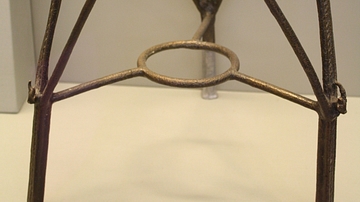
Mycenaean Bronze Tripod, Tiryns
A Mycenaean bronze tripod from Tiryns. Decorated with cow and goat heads with pomegranate and birds hanging from the upper ring. 12th century BCE. (National Archaeoloigcal Musem, Athens)
Image
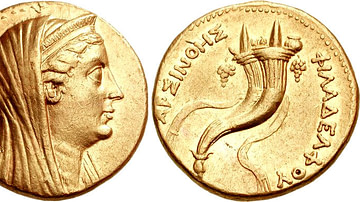
Coin Portrait of Arsinoe II
Gold octadrachm (mnaieion), from Alexandria, c. 253-246 BCE. The obverse shows the veiled portrait of Arsinoe II; the reverse illustrates a double cornucopia (dikeras), bound with a royal fillet (diadēma) and overflowing...
