
Search
Did you mean: Philosophy?
Remove Ads
Advertisement
Search Results

Definition
John Locke
John Locke (1632-1704) was an English philosopher responsible for laying the foundation of the European Enlightenment. Locke believed that each branch of government should have separate powers, that liberty must be protected from...

Definition
Democritus
Democritus (l. c. 460 - c. 370 BCE) was a Greek philosopher and younger contemporary of Socrates, born in Abdera (though other sources cite Miletus) who, with his teacher Leucippus (l. 5th century BCE), was the first to propose an...

Definition
Alchemy
Alchemy is an ancient practice aimed at recreating precious substances using recipes and transformative materials such as the philosopher's stone. Alchemists believed that materials like gold, silver, gems, and purple dye could be recreated...

Definition
Parmenides
Parmenides (l.c. 485 BCE) of Elea was a Greek philosopher from the colony of Elea in southern Italy. He is considered among the most important of the Pre-Socratic philosophers who initiated philosophic inquiry in Greece beginning...

Definition
Montesquieu
Montesquieu (1689-1757) was a French philosopher whose ideas in works like The Spirit of the Laws helped launch the Enlightenment movement in Europe. His ideas on the separation of powers, that is, between the executive, legislative...

Definition
David Hume
David Hume (1711-1776) was a Scottish philosopher, writer, historian, and important figure in the Enlightenment. Hume presented a positive view of human nature but a sceptical view of religion's usefulness. His Treatise of Human Nature...
Definition
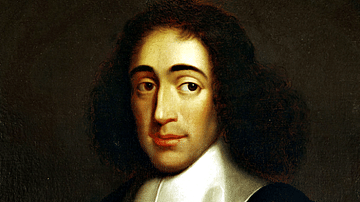
Baruch Spinoza
Baruch Spinoza (1632-1677) was a Dutch philosopher who combined rationalism and metaphysics to create a unique system of thought. Spinoza was held up as an atheist philosopher in the 18th century, but this is not an entirely accurate...

Definition
Gottfried Wilhelm Leibniz
Gottfried Wilhelm Leibniz (1646-1716) was a German polymath who became well-known across Europe for his work, particularly in the fields of science, mathematics, and philosophy. Leibniz's rationalist philosophy attempted...

Definition
Anaxagoras
Anaxagoras (l. c. 500-c. 428 BCE) was a Pre-Socratic Greek philosopher who claimed the First Cause of existence was Mind (nous) and all things were constituted of indestructible “seeds” (or “stuff”), originally a single mass, separated...

Definition
Thomas Hobbes
Thomas Hobbes (1588-1679) was an English philosopher who famously summarised his pessimistic view of human nature in his greatest work, Leviathan, published in 1651. Hobbes believed that the life of humanity in the state of nature...
