
Search
Did you mean: Persis?
Remove Ads
Advertisement
Search Results

Definition
Nanna - Mesopotamian God of the Moon and Wisdom
Nanna (also known as Nannar, Nanna-Suen, Sin, Asimbabbar, Namrasit, Inbu) is the Mesopotamian god of the moon and wisdom. He is one of the oldest gods in the Mesopotamian pantheon and is first mentioned...

Definition
Samurai
The samurai (also bushi) were a class of warriors that arose in the 10th century in Japan and which performed military service until the 19th century. Elite and highly-trained soldiers adept at using both the bow and sword, the samurai...

Definition
Yomi
Yomi, or Yomi-tsu-kuni, is the underworld of the Shinto religion, even if it forms no part of Shinto theology and appears only in ancient myths as told in the 8th-century CE Kojiki, notably the story of the creator gods Izanami and Izanagi...

Definition
Varangian Guard - Bodyguard of the Byzantine Emperors
The mercenary Varangian Guard was an elite Byzantine army corps and the personal bodyguard of emperors beginning with Basil II in c. 988 CE. The Viking unit was famous for the stature of its members...

Definition
Tiridates I of Armenia
Tiridates I (Trdat I) ruled as the king of Armenia from 63 to either 75 or 88 CE). Considered the founder of the Arsacid dynasty proper, his reign got off to a rocky start with invasions from Rome and Parthia but, once crowned...

Definition
Fertile Crescent - A Modern Term For An Ancient Region
The Fertile Crescent, often called the 'cradle of civilization', is the region in the Middle East that curves like a quarter-moon shape from the Persian Gulf through modern-day southern Iraq, Syria...
Definition
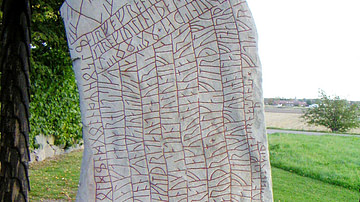
Runes
Runes are letters in the runic alphabets of Germanic-speaking peoples, written and read most prominently from at least c. 160 CE onwards in Scandinavia in the Elder Futhark script (until c. 700 CE) and the Younger Futhark - which illuminated...

Definition
The Eumenides
The Eumenides is a play written by Aeschylus (c 525 – 455 BCE), the “Father of Greek Tragedy,” the most popular and influential of all tragedians of his era. The Eumenides was the third play of a trilogy, The Oresteia, with the...

Definition
Hildegard of Bingen
Hildegard of Bingen (also known as Hildegarde von Bingen, l. 1098-1179) was a Christian mystic, Benedictine abbess, and polymath proficient in philosophy, musical composition, herbology, medieval literature, cosmology, medicine...

Definition
Kamakura
Kamakura is a coastal town located on Sagami Bay on Honshu Island, Japan, which was the capital of the Kamakura Shogunate from 1192 to 1333 CE. Provided with excellent natural defensive features, it was fortified and made the base of...
