
Search
Remove Ads
Advertisement
Search Results
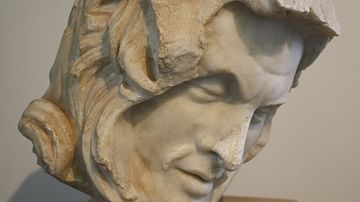
Definition
Peace of Callias
The Peace of Callias (aka Kallias) refers to a possible peace treaty made in the mid-5th century BCE between Athens and Persia following the Persian Wars. The existence of such a treaty is not agreed upon by all historians, and...

Article
Death and the Afterlife in Ancient Persia
A vision of the afterlife is articulated by every culture, ancient or modern, in an effort to answer the question of what happens after death. Ancient Persia had the same interest in this as any culture of...

Definition
Xerxes I
Xerxes I (l. 519-465, r. 486-465 BCE), also known as Xerxes the Great, was the king of the Persian Achaemenid Empire. His official title was Shahanshah which, though usually translated as `emperor', actually means `king of kings'. He...

Definition
Cyrus the Great
Cyrus II (d. 530 BCE), also known as Cyrus the Great, was the fourth king of Anshan and the first king of the Achaemenid Empire. Cyrus led several military campaigns against the most powerful kingdoms of the time, including Media...

Definition
Alexander I the Philhellene
Alexander I of Macedon, also known as Alexander I the Philhellene ('friend of the Greeks') or 'The Wealthy', was king of ancient Macedon from around 498 to 454 BCE. He is known for the role he played in the second Persian...

Article
Achaemenid Kings List & Commentary
The Achaemenid Empire (c. 550-330 BCE) was the first great Persian political entity in Western and Central Asia which stretched, at its peak, from Asia Minor to the Indus Valley and Mesopotamia through Egypt. It...
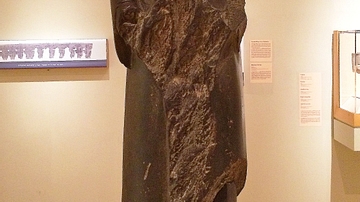
Image
Statue of the Egypto-Persian Ptahhotep
This statue of Ptahhotep (who was the Overseer of the Treasury) is shown in a Persian costume that Egyptian officials adopted when Egypt was under Persian control. The jacket with flaring sleeves, over which...

Video
The Silk Road and Ancient Trade: Crash Course World History #9
The Silk Road and Ancient Trade: In which John Green teaches you about the so-called Silk Road, a network of trade routes where goods such as ivory, silver, iron, wine, and yes, silk were exchanged...
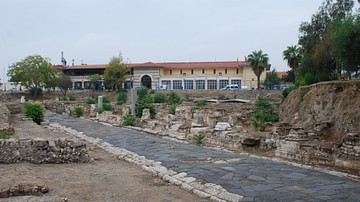
Image
Roman Road, Tarsus
Remains of a Roman road in Tarsus, Cilicia.
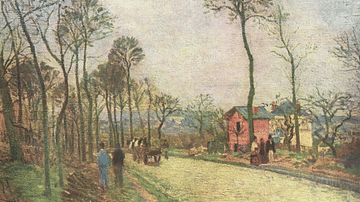
Image
The Road to Louveciennes by Pissarro
An 1870 oil on canvas landscape, The Road to Louveciennes, by Camille Pissarro (1830-1903), the Danish-French impressionist painter. The simple composition and colour tones are typical of the artist's work in this...
