
Search
Remove Ads
Advertisement
Search Results

Definition
Thirteen Colonies
The Thirteen Colonies were a cluster of British colonies located along the Atlantic seaboard of North America. Founded for a variety of reasons – economic, political, and religious – the colonies emerged with their own distinct...

Definition
Underground Railroad - Pathways to Freedom
The Underground Railroad was a decentralized network of White abolitionists, free Blacks, former slaves, Mexicans, Native Americans, and others opposing slavery in the United States who established secret routes...

Definition
John André
Major John André (1750-1780) was a British military officer who served in the American Revolutionary War (1775-1783). He is best known for negotiating with the American turncoat Benedict Arnold, who offered to hand over the stronghold...

Definition
William Howe
Sir William Howe (1729-1814) was a British military officer and politician, most notable for his role as commander-in-chief of the British army during the initial years of the American Revolutionary War (1775-1783). Despite several...

Definition
Conway Cabal
The Conway Cabal was a movement undertaken by American military officers and political leaders to remove General George Washington from command of the Continental Army during the winter of 1777-78. These Patriot leaders had lost...

Article
Battle of Trenton
The Battle of Trenton (26 December 1776) was an important battle of the American Revolutionary War (1775-1783). On Christmas Day 1776, General George Washington led his Continental Army across the Delaware River to launch a surprise...

Definition
First Continental Congress
The First Continental Congress was a meeting of delegates from twelve of the Thirteen Colonies of British North America that gathered in Philadelphia, Pennsylvania, from 5 September to 26 October 1774. Its primary purpose...

Definition
Mary Cassatt
Mary Cassatt (1844-1926) was an American impressionist painter who lived most of her life in France. She focussed on capturing women at their daily tasks in oils, pastels, and prints, and produced many innovative representations...
Article
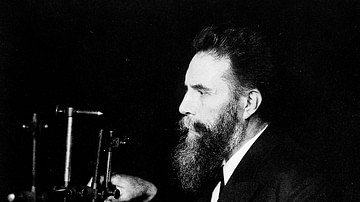
Discovery of X-Rays
The discovery of X-rays – a form of invisible radiation that can pass through objects, including human tissue – revolutionised science and medicine in the late 19th century. Wilhelm Conrad Röntgen (1845-1923), a German scientist...

Article
US Presidential Election of 1800
The US presidential election of 1800, referred to by Jeffersonians as the Revolution of 1800, was a turning point in the early political history of the United States. It resulted in the victory of Vice President Thomas...
