
Search
Did you mean: Peloponnese?
Search Results
Definition
Artaxerxes I
Artaxerxes I (r. 465-424 BCE) was the sixth monarch of the Achaemenid Persian Empire. He was the son of Xerxes I (r. 486-465 BCE) and his principal wife Amestris (d. 424 BCE) and grandson of Darius I (the Great, r. 522-486 BCE). He continued...

Article
The Plague at Athens, 430-427 BCE
In the second year of the Peloponnesian War, 430 BCE, an outbreak of plague erupted in Athens. The illness would persist throughout scattered parts of Greece and the eastern Mediterranean until finally dying out in 426 BCE. The origin of...

Definition
Athens
Athens, Greece, with its famous Acropolis, has come to symbolize the whole of the country in the popular imagination, and not without cause. It not only has its iconic ruins and the famous port of Piraeus but, thanks to ancient writers, its...

Definition
Tegea
Tegea was an ancient Greek city-state or polis in the southeast of Arcadia in the Peloponnese. The city participated in wider Greek affairs such as the Persian Wars of the early 5th century BCE and was a valuable ally of Sparta during the...

Article
Achaemenid Kings List & Commentary
The Achaemenid Empire (c. 550-330 BCE) was the first great Persian political entity in Western and Central Asia which stretched, at its peak, from Asia Minor to the Indus Valley and Mesopotamia through Egypt. It was founded by Cyrus II (the...

Article
Battle of the Eurymedon, c. 466 BCE
The Battle of the Eurymedon (c. 466 BCE, also given as the Battle of the Eurymedon River) was a military engagement between the Greeks of the Delian League and the forces of the Achaemenid Empire toward the end of the reign of Xerxes I (r...

Definition
Aspasia of Miletus
Aspasia of Miletus (l. c. 470-410/400 BCE) is best known as the consort of the great Athenian statesman Pericles. Her life story has always been given in the shadow of Pericles' fame, but she was a woman of great eloquence and intelligence...
Article
The Desecration of the Statues of Hermes, 415 BCE
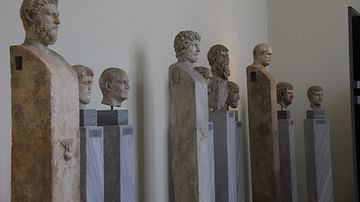
On 7 June 415 BCE, various statues of the god Hermes were desecrated in Athens. The Peloponnesian War (431-404 BCE) had been raging for decades as one of the biggest civil wars in Ancient Greece, and the Athenians prepared for the expedition...

Article
The Delian League, Part 5: The Peace of Nicias, Quadruple Alliance, and Sicilian Expedition (421/0-413/2 BCE)
This text is part of an article series on the Delian League. The fifth phase of the Delian League begins with the Peace of Nicias – a settlement that settled nothing – and ends with the start of the Decelean War (also referred to as the...
Definition
Isocrates
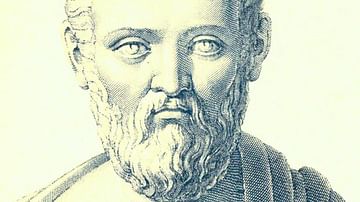
Isocrates (436-338 BCE) was an ancient Athenian rhetorician, characterized as one of the most prominent orators of his time, even though it appears that he restricted himself to writing speeches and not orating them himself. His most notable...
