
Search
Did you mean: Pandora?
Remove Ads
Advertisement
Search Results

Definition
Cniva - The Goth King Who Defeated Rome
Cniva (also given as Kniva, reign circa 250 to possibly 270) was the king of the Goths who defeated Emperor Decius (reign 249-251) at the Battle of Abritus in 251. Little is known of him other than his campaign...
Image
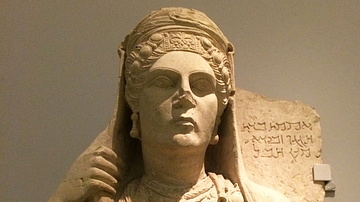
Funerary Bust of a Palmyrene Lady
This funerary bust of a Palmyrene lady dates from c. 175-200 CE and is made of limestone. It is originally from Palmyra, Syria. (Inscribed in Aramaic: ‘Aqmat, daughter of Hagagu, descendant of Zebida, descendant...

Article
Hadrian's Travels
No other Roman emperor travelled as much as Hadrian (r. 117-138 CE). The 'restless' emperor spent more time travelling than in Rome, devoting half of his 21-year reign to the inspection of the provinces. His travels provided...
Image
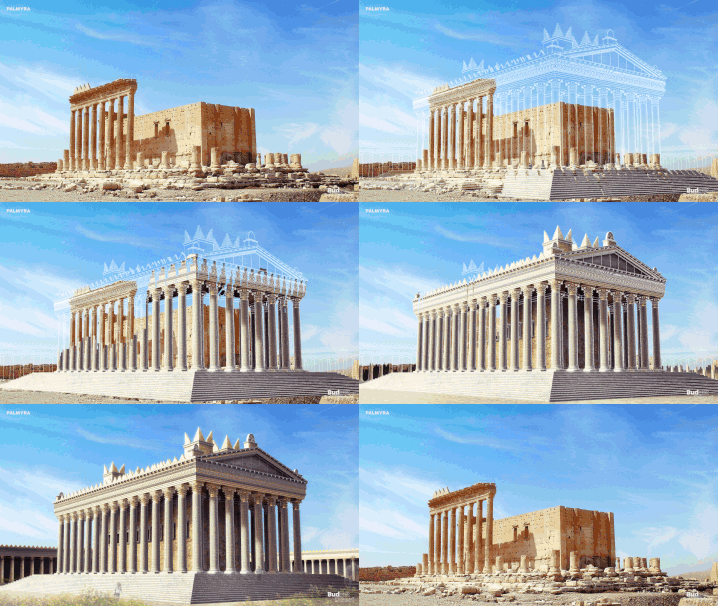
Temple of Bel, Reconstructed
A modern restoration of the Temple of Bel (also known as the Temple of Baal) in Palmyra. The temple was constructed in 32 CE, and was one of the most well-preserved temples in Syria until it was partially destroyed by...
Image
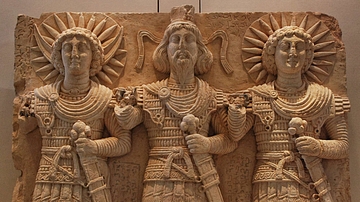
Aglibol, Baalshamin, and Malakbel
Limestone relief from Palmyra (Syria) showing the moon god Aglibol, the supreme god Baalshamin, and the sun god Malakbel (from left to right). First half of the first century CE. Exhibited in the Louvre Museum, Paris...
Image
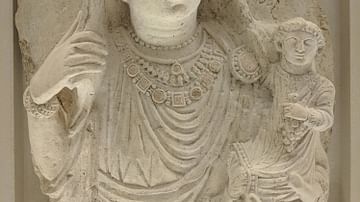
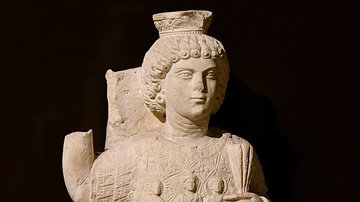
Bust of Habba, a Palmyrene Woman
Bust of Habba, daughter of 'Oga, son of Yarhai, shown carrying a child on her left arm. 3rd century CE, Palmyra, modern-day Syria.
Louvre Museum, Paris.
Image
Statue Dedicated to Jupiter Heliopolitanus
This limestone statue was dedicated to Jupiter Heliopolitanus by Sextus Proculus, the commander of the 2nd cohort. Roman Period, 2nd century CE. From Sukhne, northeast of Palmyra, in modern-day Syria. (Museum...

Image
Zenobia Being Captured by the Romans
Zenobia of Palmyra (born c. 240 CE, death date unknown) is captured by Roman cavalry, by Zvonimir Grbasic. Courtesy of Ancient History Magazine / Karwansaray Publishers.
Image
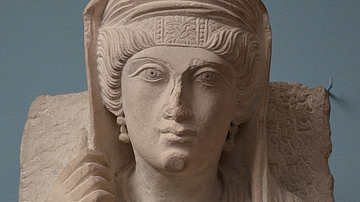
The lady Marti relief
The lady Marti, a funerary portrait of a woman from Palmyra, c. 170-190 CE (Ny Carlsberg Glyptotek, Copenhagen).

Video
The Warrior Queen Zenobia of the Palmyrene Empire
The warrior queen Zenobia of the Palmyrene Empire ruled her kingdom for three years until the Roman Emperor Aurelian stopped her in her tracks. The Palmyrene Empire was an empire that broke away from...
