
Search
Did you mean: Fasces?
Remove Ads
Advertisement
Search Results

Definition
Giotto
Giotto di Bondone (b. 1267 or 1277 - d. 1337 CE), usually referred to as simply Giotto, was an Italian painter and architect whose work was hugely influential in the history of Western art. Giotto is most famous today for the cycle of...

Definition
Philippi
Philippi was an important city in eastern Macedon which flourished in the Hellenistic, Roman, and Byzantine Periods. Situated between the Strymon and Nestos rivers, the city was valued in antiquity for its nearby gold mines. Site of...

Definition
Belisarius
Flavius Belisarius (l. 505-565 CE) was born in Illyria (the western part of the Balkan Peninsula) to poor parents and rose to become one of the greatest generals, if not the greatest, of the Byzantine Empire. Belisarius is listed...

Definition
Sulla
Lucius Cornelius Sulla (138-78 BCE) was a ruthless military commander, who first distinguished himself in the Numidian War under the command of Gaius Marius. His relationship with Marius soured during the conflicts that would follow and...

Definition
Hundred Days
The Hundred Days refers to the second reign of French Emperor Napoleon I, who unexpectedly returned from exile to reclaim the French throne. It encompasses Napoleon's triumphant return to Paris on 20 March 1815, his climactic defeat...

Definition
Jan Hus
Jan Hus (also John Huss, l. c. 1369-1415) was a Czech philosopher, priest, and theologian who, inspired by the work of John Wycliffe (l. 1330-1384) challenged the policies and practices of the medieval Church and so launched the Bohemian...

Definition
Castor and Pollux
Castor and Pollux (the Dioscuri) are figures from Greek and Roman mythology considered the twin sons of Zeus or Jupiter. Semi-divine figures, the twins were credited with the role of saving those in trouble at sea or in grave...

Definition
Mosaic
Mosaics are designs and images created using small pieces (tesserae) of stone or other materials which have been used to decorate floors, walls, ceilings, and precious objects since before written records began. Like pottery, mosaics...
Definition
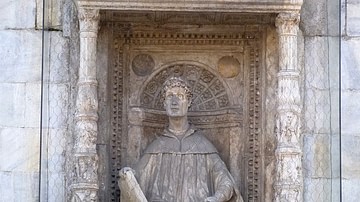
Pliny the Younger
Pliny the Younger (61-112 CE) was the nephew of Pliny the Elder (23-79 CE), the author of the 37-volume Natural History. He had a remarkable political career and gained a reputation as an excellent lawyer and orator, but he is...

Definition
Temple of Garni
The Temple of Garni (Armenian: “Garnu tacar”) is located in the village of Garni in Kotayk Province, Armenia, and it was once a pagan temple dedicated to the Armenian sun god Mihr. Built in the middle of the 1st century CE, the...
