
Search
Did you mean: Muse?
Remove Ads
Advertisement
Search Results

Article
Egyptian Mummies at the Montreal Museum of Fine Arts
The Montreal Museum of Fine Arts (Musée des beaux-arts de Montréal) is currently hosting the North American premiere of the exhibition Egyptian Mummies: Exploring Ancient Lives. Visitors can meet six mummies who lived in ancient Egypt from...

Interview
Tutankhamun and the Tomb that Changed the World with Dr. Bob Brier
Join World History Encyclopedia as they sit down with Dr. Bob Brier to chat all about his new book Tutankhamun and the Tomb That Changed the World, published by Oxford University Press. Kelly: Welcome. Thank you so much for joining me today...

Definition
Fayum
The Faiyum (also given as Fayoum, Fayum, and Faiyum Oasis) was a region of ancient Egypt known for its fertility and the abundance of plant and animal life. Located 62 miles (100 kilometers) south of Memphis (modern Cairo), the Faiyum was...
Article
Tomb Robbing in Ancient Egypt
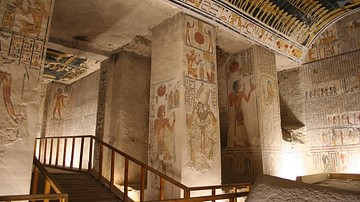
The tombs of the great kings and nobles of Egypt were built to safeguard the corpse and possessions of the deceased for eternity and yet, while many have endured for thousands of years, their contents often disappeared relatively quickly...

Definition
Nefertiti
Nefertiti (c. 1370 - c. 1336 BCE) was the wife of the pharaoh Akhenaten of the 18th Dynasty of Egypt. Her name means, `the beautiful one has come' and, because of the world-famous bust created by the sculptor Thutmose (discovered in 1912...

Definition
Ankhsenamun
Ankhsenamun (born c. 1350 BCE and known as Ankhesenpaaten in youth) was the daughter of Akhenaten and Nefertiti of the 18th Dynasty of Egypt. She was married to her father and may have borne him one daughter, Ankhesenpaaten Tasherit ('Ankhesenpaaten...

Article
Mummification in Ancient Egypt
The practice of mummifying the dead began in ancient Egypt c. 3500 BCE. The English word mummy comes from the Latin mumia which is derived from the Persian mum meaning 'wax' and refers to an embalmed corpse which was wax-like. The idea of...

Article
Queen Hatshepsut: Daughter of Amun, Pharaoh of Egypt
Hatshepsut, whose name means "Foremost of Noble Women" or "First Among Noble Women" (royal name, Ma'at-ka-re, translated as "spirit of harmony and truth") was the fifth ruler of the 18th Dynasty (r. 1479-1458 BCE). She was the daughter of...
Article
Pets in Ancient Egypt
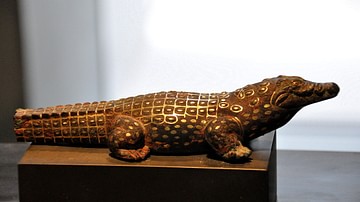
Pets were very important to the ancient Egyptians and considered gifts from the gods to be cared for until their death when they were expected to be returned to the divine realm from which they had come. In life, pets were well cared for...
Definition
Tiye
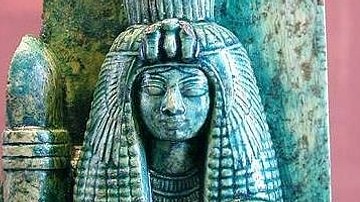
Tiye (also known as Tiy, 1398-1338 BCE) was a queen of Egypt of the 18th dynasty, wife of the pharaoh Amenhotep III, mother of Akhenaten, and grandmother of both Tutankhamun and Ankhsenamun. She exerted an enormous influence at the courts...
