
Search
Remove Ads
Advertisement

 This answer was generated by
 Search Results

Definition
Motte and Bailey Castle
The motte and bailey castle was an early form of medieval fortification especially popular with the Normans in northern France and Britain during the 11th century CE. A single tower was built on (or partially within) the motte or earth mound...

Image
Motte and Bailey Castle, Bayeux Tapestry
A detail from the Bayeux tapestry showing the motte and bailey structure of Dinan during the 11th century Norman conquest of Britain. The wooden palisade sits atop the motte or mound. (Centre Guillaume le Conquérant, Bayeux, France)
Image
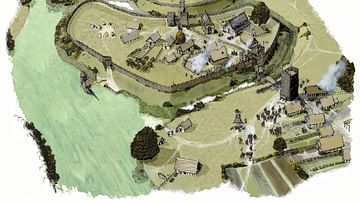
Motte and Bailey Castle Diagram
A diagram of the motte-and-bailey castle of Huntingdon Hill, England. 11th century CE. Huntingdon was an urban centre with a mint, a market and several churches. The castle's construction was initiated by William the Conqueror in 1068 to...

Definition
Castle Keep - The Safest Place in a Medieval Castle
The keep, located within a courtyard and surrounded by a curtain wall, was the heart of a medieval castle. The hall keep was a low building while the tower keep or donjon could have three or more floors and be topped by turrets and battlements...

Definition
Medieval Castle
Medieval castles were built from the 11th century CE for rulers to demonstrate their wealth and power to the local populace, to provide a place of defence and safe retreat in the case of attack, defend strategically important sites like river...

Article
The Impact of the Norman Conquest of England
The Norman conquest of England, led by William the Conqueror (r. 1066-1087 CE) was achieved over a five-year period from 1066 CE to 1071 CE. Hard-fought battles, castle building, land redistribution, and scorched earth tactics ensured that...

Article
William the Conqueror's Harrying of the North
By the end of 1066 CE William the Conqueror had won a decisive victory at the Battle of Hastings, subdued the south-east of England and been crowned King William I in Westminster Abbey but there remained rebellion in the air throughout 1067...

Article
Affair of the Diamond Necklace
The affair of the diamond necklace (1784-86) was a scandal that centered around Queen Marie Antoinette of France (l. 1755-1793). Although the queen was innocent of any involvement in a plot to steal a luxurious diamond necklace, the scandal...

Article
Siege Warfare in Medieval Europe
Siege tactics were a crucial part of medieval warfare, especially from the 11th century CE when castles became more widespread in Europe and sieges outnumbered pitched battles. Castles and fortified cities offered protection to both the local...

Definition
Norman Conquest of England
The Norman Conquest of England (1066-71) was led by William the Conqueror who defeated King Harold II at the Battle of Hastings in 1066. The Anglo-Saxon elite lost power as William redistributed land to his fellow Normans. Crowned William...
