
Search
Did you mean: Solon?
Remove Ads
Advertisement
Search Results

Definition
Coyolxauhqui
Coyolxauhqui (pron. Koy-ol-shauw-kee) was the Aztec goddess of the Moon or Milky Way who was famously butchered by her brother Huitzilopochtli, the god of war, in Aztec mythology. This story was commemorated in a celebrated large...

Definition
Inca Religion
For the Incas, as with many other ancient cultures, religion was inseparable from politics, history, and society in general. All facets of community life were closely connected to religious beliefs, from marriages to agriculture...

Definition
Chaco Canyon
Chaco Canyon was the center of a pre-Columbian civilization flourishing in the San Juan Basin of the American Southwest from the 9th to the 12th century CE. Chacoan civilization represents a singular period in the history of an ancient...

Definition
Claudius Ptolemy
Claudius Ptolemy (c. 100 to c. 170 CE) was an Alexandrian mathematician, astronomer, and geographer. His works survived antiquity and the Middle Ages intact, and his theories, particularly on a geocentric model of the universe...

Definition
Ishtar
Ishtar (Inanna in Sumerian sources) is a primary Mesopotamian goddess closely associated with love and war. This powerful Mesopotamian goddess is the first known deity for which we have written evidence. While largely unknown in the modern...

Definition
Hecate
Hecate (Hekate) is a goddess of Greek mythology capable of both good and evil. She was associated with witchcraft, magic, the Moon, doorways, and creatures of the night like hell-hounds and ghosts. Hecate often carries a torch in her...
Definition
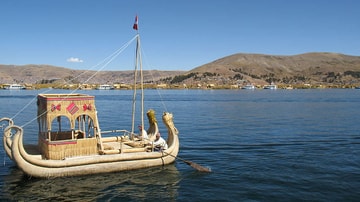
Lake Titicaca
Lake Titicaca is located between Bolivia and Peru and, at an altitude of 3,800 metres (12,500 feet), it is the world's highest navigable lake. The tundra plain known as the altiplano stretches to the south and was the location of...

Article
Paiyatuma & the Maidens of the Corn
Paiyatuma and the Maidens of the Corn is a legend of the Zuni nation of the Pueblo peoples of the Southwest of the modern-day USA. Paiyatuma (also given as Paiyatamu) is a kachina spirit – an elemental entity –...

Article
Astronomy in the Scientific Revolution
The astronomers of the Scientific Revolution rejected long-held theories of ancient thinkers like Claudius Ptolemy and Aristotle and instead set out to systematically observe the heavens in order to create a...

Article
15 Complete Hyangga Songs from Ancient Korea
Hyangga was a form poetical 'country song,' distinct from contemporary Chinese songs, which were written in the Silla and Goryeo kingdoms of ancient Korea between the 7th and 10th century CE. The indigenous...
