
Search
Remove Ads
Advertisement
Search Results

Definition
Yomi
Yomi, or Yomi-tsu-kuni, is the underworld of the Shinto religion, even if it forms no part of Shinto theology and appears only in ancient myths as told in the 8th-century CE Kojiki, notably the story of the creator gods Izanami and Izanagi...

Definition
Canyon de Chelly
Canyon de Chelly or Canyon de Chelly National Monument is a protected site that contains the remains of 5,000 years of Native American inhabitation. Canyon de Chelly is located in the northeastern portion of the US state of Arizona...

Definition
Hadrian
Hadrian (l. 78-138 CE) was emperor of Rome (r. 117-138 CE) and is recognized as the third of the Five Good Emperors (Nerva, Trajan, Hadrian, Antoninus Pius, and Marcus Aurelius) who ruled justly. His reign marked the height of the Roman...
Definition
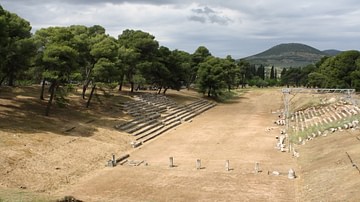
Stadium - The Sports Field of Ancient Greece
In the ancient Greek world, the word stadium or stadion referred to a measurement of distance, a foot-race, and the place where the race was held and observed by spectators. The Great Games Greek sporting...

Definition
Cyclops (Creature)
A cyclops (meaning 'circle-eyed') is a one-eyed giant first appearing in the mythology of ancient Greece. The Greeks believed that there was an entire race of cyclopes who lived in a faraway land without law and order. Homer...

Definition
Sioux Warrior Rain-in-the-Face (Eastman's Biography)
Rain-in-the-Face (Ite Omagazu, l. c. 1835-1905) was a Lakota Sioux warrior and war chief during Red Cloud's War (1866-1868) and at the Battle of the Little Bighorn (1876), after which he became famous...

Definition
Sargonid Dynasty
The Sargonid Dynasty was the last ruling house of the Neo-Assyrian Empire from 722-612 BCE, beginning with the reign of Sargon II and ending with fall of the Neo-Assyrian Empire. Some of the most famous kings in the history of...

Definition
Greek Dark Age
The Greek Dark Age (c. 1200 to c. 800 BCE, overlapping with the Iron Age, c. 1200-550 BCE) is the modern-day term for the period in Greek history following the Bronze Age Collapse when the Mycenaean Civilization fell and the Linear...
Definition
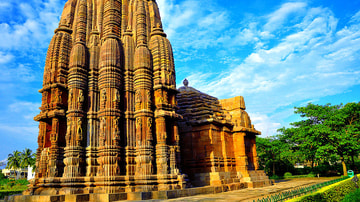
Bhubaneshwar
Bhubaneshwar (also spelt Bhubaneswar, Bhubanesar, and Bhuvanesvar) is a city located in the Orissa district of north-eastern India and flourished as a centre of Hindu worship from the 7th century CE. Its mass of well-preserved sandstone...

Definition
Nebuchadnezzar II
Nebuchadnezzar II (r. 605/604-562 BCE) was the greatest King of ancient Babylon during the period of the Neo-Babylonian Empire (626-539 BCE), succeeding its founder, his father, Nabopolassar (r. 626-605 BCE). He is best known...
