
Search
Remove Ads
Advertisement
Search Results

Definition
Tegea
Tegea was an ancient Greek city-state or polis in the southeast of Arcadia in the Peloponnese. The city participated in wider Greek affairs such as the Persian Wars of the early 5th century BCE and was a valuable ally of Sparta during...

Definition
Greco-Bactrian Kingdom
The Greco-Bactrian kingdom refers to several dynasties and probably kingdoms of Greco-Macedonian monarchs who ruled over Bactria from 250 to 130 BCE. Foundation The Greco-Bactrian kingdom appeared in 250 BCE, when the...

Definition
Gwanggaeto the Great
Gwanggaeto (Kwanggaeto), often referred to as Gwanggaeto the Great, was king of the Goguryeo (Koguryo) kingdom which ruled northern Korea during the Three Kingdoms period. Gwanggaeto reigned between 391 and 413 CE, and living...
Definition
Indo-Greek
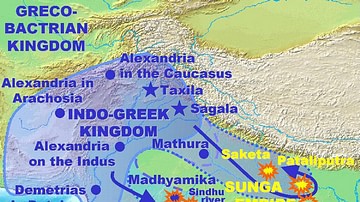
The first Indo-Greek kingdom appeared circa 190 BCE may when the Greco-Bactrian king or (general for his father) Demetrios was busy in India, when his Indian possessions were divided between several kings, probably firstly in order...

Definition
Ancient Egyptian Warfare - The Force That Built an Empire
Ancient Egyptian Warfare developed from an army of conscripts in the Pre-Dynastic Period (circa 3150-2613 BCE) through the early era of the Middle Kingdom (2040-1782 BCE), supplied to the king by...
Definition
Scythians
The Scythians were a nomadic people whose culture flourished between the 7th and 3rd century BCE in a territory ranging from Thrace in the west, across the steppe of Central Asia, to the Altai Mountains of Mongolia in the east. This...

Definition
Arminius
The Cherusci noble Arminius (c. 18 BCE - 19 CE) led the resistance to Roman conquest of Germania during the years 9-16 CE. Likely raised as a child hostage in Rome, Arminius gained command of a German auxiliary cohort in the Roman army...

Definition
Claudius - The Unlikely Roman Emperor
Claudius (10 BCE to 54 CE) was the fourth Roman emperor, who reigned from 41 to 54 CE. Though a member of the imperial Julio-Claudian Dynasty, his rise to power had always seemed unlikely. Indeed, for much of his...

Definition
Hyangga
Hyangga was a form poetical 'country song,' distinct from contemporary Chinese songs, which were written in the Silla and Goryeo kingdoms of ancient Korea between the 7th and 10th century CE. The indigenous songs cover such topics as...

Definition
Shapur I
Shapur I (r. 240-270 CE) is considered one of the greatest kings of the Sassanian Empire for expanding his realm, his policy of religious tolerance, building projects, and committing the Zoroastrian scriptures (Avesta) to writing. He...
