
Search
Remove Ads
Advertisement
Search Results

Definition
Native Peoples of North America
The Native Peoples of North America (also known as American Indians, Native Americans, Indigenous Americans, and First Americans) are the original inhabitants of North America believed to have migrated into the region...

Definition
Nebuchadnezzar II
Nebuchadnezzar II (r. 605/604-562 BCE) was the greatest King of ancient Babylon during the period of the Neo-Babylonian Empire (626-539 BCE), succeeding its founder, his father, Nabopolassar (r. 626-605 BCE). He is best known...

Definition
Greek Colonization
From around 800 BCE, ancient Greek city-states, most of which were maritime powers, began to look beyond Greece for land and resources. As a consequence, they founded colonies across the Mediterranean. Trade was usually the...

Definition
Montesquieu
Montesquieu (1689-1757) was a French philosopher whose ideas in works like The Spirit of the Laws helped launch the Enlightenment movement in Europe. His ideas on the separation of powers, that is, between the executive, legislative...
Definition
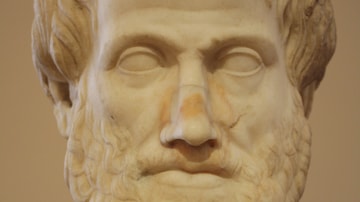
Aristotle
Aristotle of Stagira (l. 384-322 BCE) was a Greek philosopher who pioneered systematic, scientific examination in literally every area of human knowledge and was known, in his time, as "the man who knew everything" and later simply...

Definition
Near East - A Modern Term for an Ancient Land
The 'Near East' is a modern-age term for the region formerly known as the 'Middle East,' comprising Armenia, Cyprus, Egypt, Iraq, Iran, Israel, Jordan, Lebanon, Palestine, Syria, and part of Turkey, corresponding...

Definition
Adam Smith
Adam Smith (1723-1790) was a Scottish philosopher, economist, and leading Enlightenment figure. In The Wealth of Nations, he advocates free trade and limited interference in markets by governments, for which he is seen as the founder...

Definition
Neo-Assyrian Empire
The Neo-Assyrian Empire (912-612 BCE) was the final stage of the Assyrian Empire, stretching throughout Mesopotamia, the Levant, Egypt, Anatolia, and into parts of Persia and Arabia. Beginning with the reign of Adad Nirari...

Definition
Prince Henry the Navigator
Prince Henry the Navigator (aka Infante Dom Henrique, 1394-1460) was a Portuguese prince who famously helped capture the North African city of Ceuta, sponsored voyages of exploration with the aim of building colonies in...

Definition
Astrolabe
The astrolabe is an astronomical instrument used from around the 6th century to measure time and position by determining the altitude of heavenly bodies like the Sun and certain stars. Measurements were taken in reference to the viewer's...
