
Search
Remove Ads
Advertisement
Search Results

Article
The Ancient Celtic Pantheon
The ancient Celtic pantheon consisted of over 400 gods and goddesses who represented everything from rivers to warfare. With perhaps the exception of Lugh, the Celtic gods were not universally worshipped across Iron Age...

Article
The Anglo-German Arms Race - Riding the Waves to WWI
The pre-First World War arms race between Britain and Germany was fuelled by Britain's desire to protect its empire, Germany's desire to build an empire, and a general atmosphere of suspicion amongst...

Article
Hitler's Occupation of Czechoslovakia
Throughout 1938, Adolf Hitler (1889-1945), the leader of Nazi Germany, threatened to occupy the Sudetenland region of Czechoslovakia. The excuse presented was that Sudeten Germans were being repressed but Hitler...

Article
12 Key Women in Revolutionary Russia
Women were involved in all aspects of the Russian Revolutions of 1905 and 1917 when radical socialists and other sections of society challenged the authoritarian rule of Tsar Nicholas II (reign 1894-1917). As writers...

Definition
Johann Sebastian Bach
Johann Sebastian Bach (1685-1750) was a German organist and composer whose work is today regarded as amongst the finest of mature baroque music (c. 1600-1750). More famous as an organist than as a composer in his own lifetime...

Definition
Manuel I Komnenos
Manuel I Komnenos was emperor of the Byzantine Empire from 1143 to 1180 CE. Manuel continued the ambitious campaigns of his grandfather Alexios I and father John II to aggressively expand the boundaries of his empire. Manuel...
Article
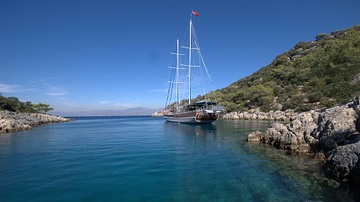
Travelling Along the Lycian Way
The Lycian Way follows over 540km (335 miles) of ancient roadways, mule tracks and shepherds' paths along one of Turkey's most remote and untouched coastlines. Theresa Thompson discovers the joys of following the trail...

Article
Why Poland-Lithuania Disappeared
The Polish-Lithuanian Republic (1569-1795) was one of the largest and most populous states in Early Modern Europe, yet in 1795, its last remnants were partitioned between Austria, Prussia, and Russia. Here we take...

Article
Louis XVI, the Girondins, & the Road to Revolutionary War (1791-92)
On 20 April 1792, King Louis XVI of France (r. 1774-1792) stood before the Legislative Assembly and, with a faltering voice, read a declaration of war against Austria, to the ecstatic delight...

Definition
Treaty of Versailles
The Treaty of Versailles, signed in June 1919, was an agreement between the victors of the First World War (1914-18) which redivided parts of Europe and imposed reparations, armament limitations, and total blame for the war...
