
Search
Did you mean: Lycia?
Remove Ads
Advertisement
Search Results

Definition
Arminius
The Cherusci noble Arminius (c. 18 BCE - 19 CE) led the resistance to Roman conquest of Germania during the years 9-16 CE. Likely raised as a child hostage in Rome, Arminius gained command of a German auxiliary cohort in the Roman army...

Definition
Dacia
Dacia was a region inhabited by the Dacians in the north of the Danube (modern Romania). The kingdom of Dacia was the creation of Burebistas (c. 80-44 BCE), who conquered and united several other Dacian principalities. Burebistas practically...

Definition
Hyangga
Hyangga was a form poetical 'country song,' distinct from contemporary Chinese songs, which were written in the Silla and Goryeo kingdoms of ancient Korea between the 7th and 10th century CE. The indigenous songs cover such topics as...

Definition
Sasanian Empire
The Sasanian Empire (224-651 CE, also given as Sassanian, Sasanid or Sassanid) was the last pre-Islamic Persian empire, established in 224 CE by Ardeshir I, son of Papak, descendant of Sasan. The Empire lasted until 651 CE when...

Definition
Egyptian Papyrus
Papyrus is a plant (cyperus papyrus) which once grew in abundance, primarily in the wilds of the Egyptian Delta but also elsewhere in the Nile River Valley, but is now quite rare. Papyrus buds opened from a horizontal root growing...

Definition
Constantinople
Built in the seventh century BCE, the ancient city of Byzantium proved to be a valuable city for both the Greeks and Romans. Because it lay on the European side of the Strait of Bosporus, the Emperor Constantine understood its...

Definition
Later Three Kingdoms Period
The Later Three Kingdoms period (889-935 CE) of ancient Korea saw a partial revival of the old three kingdoms which had dominated the peninsula from the 1st century BCE to the 7th century CE. After the Unified Silla kingdom...

Definition
Justinian I
Justinian I reigned as emperor of the Byzantine Empire from 527 to 565 CE. Born around 482 CE in Tauresium, a village in Illyria, his uncle Emperor Justin I was an imperial bodyguard who reached the throne on the death of Anastasius...
Definition
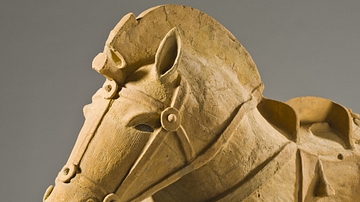
Haniwa
Haniwa are the unglazed terracotta rings, cylinders, and figures of people, animals, and houses which were deposited at Japanese tombs during the Kofun and Asuka Periods (c. 250-710 CE). The exact purpose of these offerings is not known...

Definition
Hatshepsut
Hatshepsut (r. 1479-1458 BCE) was the first female ruler of ancient Egypt to reign as a male with the full authority of pharaoh. Her name means "Foremost of Noble Women" or "She is First Among Noble Women". She began her reign as...
