
Search
Did you mean: Druid?
Remove Ads
Advertisement
Search Results

Image
Chalchiuhtlicue
Chalchiutlicue or "She of the Jade Skirt", ink and natural pigment on agave paper, unknown artist, included in the Codex Borbonicus by unknown Aztec priests, Mexico, 16th century Chalchiuhtlicue was the Aztec goddess of lakes...

Image
Libation Offered to a Vegetation Goddess
This plaque, sculpted in low relief and featuring a hole in its center, is characteristic of the period of the archaic Sumerian dynasties, from the 3rd millennium BC. The hole was probably used to attach the...

Image
A Sumerian Wall Plaque Showing Libation Scenes
The upper register shows a naked priest followed by three worshippers. The priest pours an unknown liquid offering from a spouted vessel into a stemmed dish or stand, in front of a horned god figure. In...

Image
Thermoscope
A thermoscope, an invention credited by some to Galileo (1564-1642). This type of early thermometer has a narrow tube filled with water which moves up a scale when air in the bulb is heated and so expands, pushing down the liquid...
Image
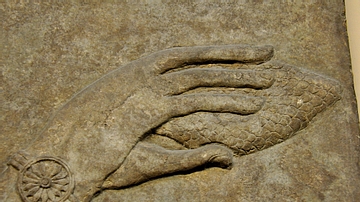
Assyrian Mullilu
This is a close-up image of a hand carrying an Assyrian mullilu; mullilu is an Akkadian word which means a purifier. This object, most likely a pine cone, was dipped into a certain liquid and then sprinkled on the Assyrian king...

Image
Greek Fire Grenades
Two clay grenades which were designed to be filled with the flammable liquid known as Greek Fire and launched at the enemy. Greek Fire was first used in the Byzantine empire in 678 CE. These examples date to between the 10th...
Image
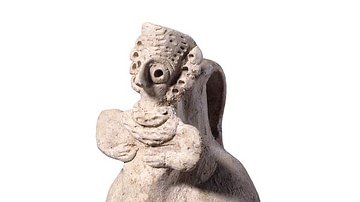
Amorite pottery juglet
Amorite, about 2400-2000 BC From the Middle Euphrates region, Syria This juglet, with its applied figurine, is pierced at the base and may have been a strainer. Alternatively it could have been used a sprinkler, by clamping...

Image
Samovar, Pompeii
A samovar was used to serve warm liquids. Charcoal in the hollow centre of the vessel heated the water within the double wall. The liquid then came out of a tap decorated as a head of an eastern barbarian. Three suspension terminals...

Image
Archaeological Remains at Lchashen, Armenia
Around the cyclopic fortress of Lchashen, there are also the remains of an ancient settlement, which date back to the 4th millennium BCE. Excavations have revealed that the settlement had straight streets...
Image
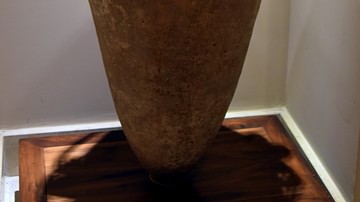
Transportation or Storage Jar from Madaba
Large jar built up with coils of clay and then trimmed upside down on the wheel. Its base is tapered making the form similar to a plumb-bob when hanged by the handles. This type of jar was commonly associated...
