
Search
Did you mean: Lamia?
Remove Ads
Advertisement
Search Results

Interview
Information & Communication Technologies in Cultural Heritage & Tourism
Information and communication technologies (ICT) are revolutionizing the ways in which the public interacts, understands, and appreciates the importance of cultural heritage around the...

Article
Ancient Roman Society
Rome began as a small city on the banks of the Tiber River in Italy. The Latin tribes (also known as the Latini or Latians) inhabited the region c. 1000 BCE but the founding of the city is dated to 753 BCE. The family was...
Article
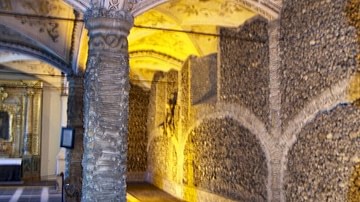
Skulls, Temples & Churches: A Visit to the Walled City of Evora
The sunbaked plain of the Alentejo region in central Portugal is called planicie dourada (golden plain) by the Portuguese, and it is dotted with cork oak forests, vineyards, olive groves...

Article
The Christian Concept of Human Sexuality as Sin
In the ancient world, human sexuality was crucial for the survival of the tribe and clan as well as pleasurable, a gift from the gods. Thousands of native cults emphasized fertility through rituals and...

Article
Why Poland-Lithuania Disappeared
The Polish-Lithuanian Republic (1569-1795) was one of the largest and most populous states in Early Modern Europe, yet in 1795, its last remnants were partitioned between Austria, Prussia, and Russia. Here we take...

Article
Beer in the Ancient World - The Drink of the Gods - For Some
The intoxicant known in English as beer takes its name from the Latin bibere (by way of the German bier), meaning "to drink", and the Spanish word for beer, cerveza, comes from the Latin word...

Article
Views of the Afterlife in Roman Tombstone Inscriptions
Ancient views of the afterlife are reflected in literature, tomb inscriptions, and grave goods. Then, as now, a belief in another stage of existence after death was a shared belief by all ancient...

Article
Marcus Aurelius: Philosopher Emperor or Philosopher-King?
Co-authored by Steven Umbrello and Tina Forsee It is very common to hear in both academic circles, as well as more close-knit Stoic circles, Marcus Aurelius (121 – 180 CE) being referred to...

Article
Jade in Mesoamerica
Jade was a highly-esteemed material in many Mesoamerican cultures, making it a valued regional trade good and first choice for objects of religious and artistic value such as masks, ceremonial axeheads, figurines, and jewellery...

Article
Anselm's Proslogion
The Proslogion (Latin for Address or Discourse; the title was chosen because it is written in the form of a prayer addressed to God) is a book written by the medieval theologian St. Anselm of Canterbury (c. 1033-1109). It is...
