
Search
Remove Ads
Advertisement
Search Results

Image
Bartolomé de las Casas
A 16th-century portrait of the Dominican friar Bartolomé de las Casas (1484-1566) who wrote a graphic description of the abuses of indigenous peoples going on in the New World in his A Very Brief Recital of the Destruction...
Image
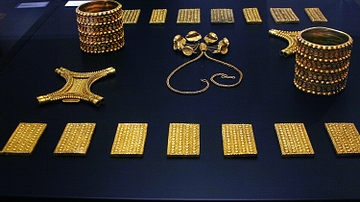
Treasure of Carambolo
The treasure of El Carambolo is a product of the Tartessan civilization. It was discovered in 1958 at the hill of El Carambolo which is about 1 km east of Seville in Spain. There are 21 pieces which total three kilograms...
Image
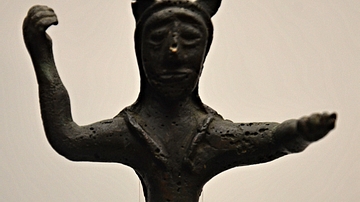
Votive Statue of Melqart
Votive statue of Melqart from Gades (Cadiz, Spain), 7th century BCE. (Archaeological Museum, Seville). Melquart was a Phoenician god and patron god of the city of Tyre.
Image
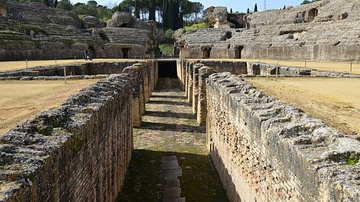
Roman Amphitheatre of Italica (Spain)
The Roman amphitheatre of Italica (located in modern-day Santiponce, 9 kilometres north of Seville in Spain) was one of the largest in the Empire, measuring 160 by 137 metres (525 by 450 feet). It was built during...
Image
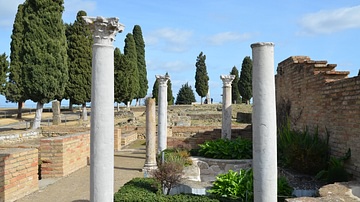
House of the Birds, Italica (Spain)
The House of the Birds is a large residence in Italica (an archaeological site located in modern-day Santiponce, 9 kilometres (5.5 miles) north of Seville in Spain) endowed with a good quantity of mosaics of high...

Image
Mosaic with Quadriga Racing Vigorously
Fragment of a mosaic with a circus scene and a quadriga (chariot led by a four-horse team) racing vigorously, found in Paradas, dated to the 4th century CE.
Museum of Archaeology, Seville.
Image
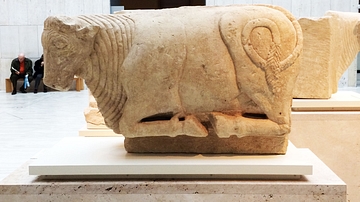
Iberian Bull Statue
This limestone statue of a bull comes from Osuna (Seville), Spain. It dates from the late 5th century CE. It was originally abutted to a funerary monument. Bulls were protectors of tombs, symbols of masculinity, and they were...

Image
The Toledo Gate in Ciudad Real
The Toledo Gate, photograph by Juan Ángel Piqueras, Ciudad Real, Castilla-La Mancha, Spain, 13 July 2026. The Toledo Gate (Spanish: La Puerta de Toledo) in Ciudad Real is a significant example of military architecture...
Image
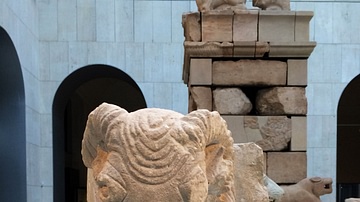
Iberian Ram Protome
Believed to be an architectural element, specifically a corbel supporting an architrave or adorning a door jamp, this ram protome is made of limestone and dates from the 2nd-1st century BCE. It comes from Osuna (Seville), Spain...
Image
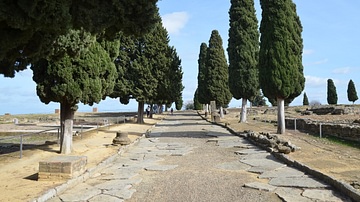
Cardo Maximus of Italica, Spain
The Cardo Maximus (north-south street) of Italica, an archaeological site located in modern-day Santiponce, 9 kilometres (5.5 miles) north of Seville in Spain.
