
Search
Remove Ads
Advertisement
Search Results

Article
Eyes on the East: Chronicles of the Indian Ocean Spice Trade
As the 15th century ended, Europeans were still mostly in the dark about the Eastern world. Early travelers like Marco Polo had given the West tidbits of information, but these accounts were...

Image
August Decrees
The National Assembly abandons its privileges during a session on the night of 4 August 1789, leading to the August Decrees that abolished feudalism in France. Engraving by Charles Monnet and Isidore-Stanislas Helman, c. 1789...
Image
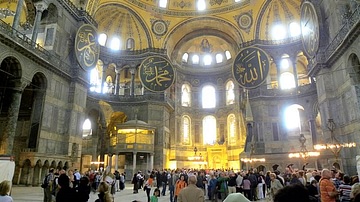
Hagia Sophia, Istanbul
Hagia Sophia was built as a church by Isidore of Miletus and Anthemius of Tralles who were chosen as architects by the Byzantine Emperor Justinian. Hagia Sophia (meaning "holy wisdom") was completed in 537 BCE and was transformed...
Image
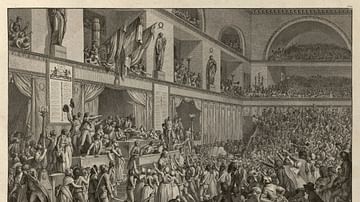
Insurrection on 1 Prairial Year III
Insurrection on 1 Prairial Year III (20 May 1795), engraving by Isidore Stanislas Helman and Jean Duplessis-Bertaux after Charles Monnet, 1796.
National Library of France, Paris.
Image
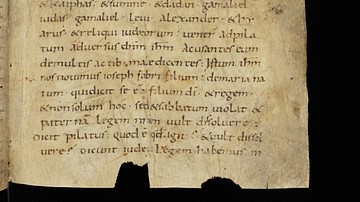
Gospel of Nicodemus
Page 66 of the 9th-10th-century manuscript of Codex 169(468), containing works by Isidore, Hucbaldus and Bernoldus as well as the Gospel of Nicodemus, copied at various times in Italy and Einsiedeln. Stiftsbibliothek, Einsiedeln...
Image
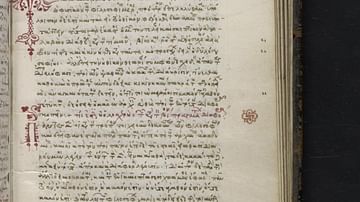
Against the Professors by Sextus Empiricus
Pros ethikous by Sextus Empiricus, manuscript written in Italy, probably Ferrara, Florence, or Rome, during Isidore's participation in the Council of Florence, 1438-1445. LJS 380, folio 244v. University of...

Video
Hagia Sophia, Istanbul, 532-37
Hagia Sophia, Istanbul, 532-37 (architects: Isidore of Miletus and Anthemius of Tralles)
A conversation with Dr. Steven Zucker and Dr. Beth Harris

Image
Map of the Taifa Kingdoms of Iberia, 1031–1086 - Al-Andalus between Córdoba and the Almoravids
The first taifa period followed the collapse of Umayyad authority in al-Andalus. The Umayyad Emirate of Córdoba (756–929) had become the Caliphate of Córdoba (929–1031...

Image
Bartolomé de las Casas
A 16th-century portrait of the Dominican friar Bartolomé de las Casas (1484-1566) who wrote a graphic description of the abuses of indigenous peoples going on in the New World in his A Very Brief Recital of the Destruction...
Image
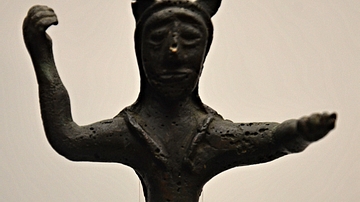
Votive Statue of Melqart
Votive statue of Melqart from Gades (Cadiz, Spain), 7th century BCE. (Archaeological Museum, Seville). Melquart was a Phoenician god and patron god of the city of Tyre.
