
Search
Remove Ads
Advertisement
Search Results
Image
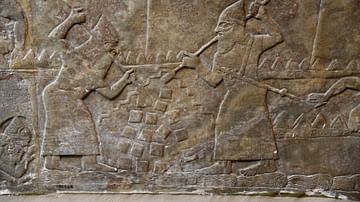
Assyrian Soldiers with Iron Crowbars
Alabaster bas-relief depicting Assyrian soldiers using iron crowbars. Neo-Assyrian Period, 865-860 BCE. Detail of Panel 4 (bottom), Room B, the North-Palace Palace, Nimrud, modern-day Iraq. (The British Museum...
Image
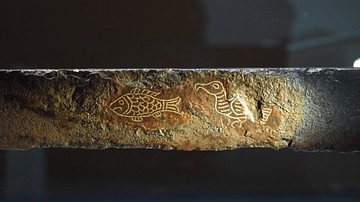
Japanese Inlaid Iron Sword (Detail)
A detail of an inlaid iron sword. From Eta Funayama Tumulus, Nagomi-machi, Tamana-gun, Kumamoto, Japan. Kofun Period, 5th-6th century CE. National Treasure.
Tokyo National Museum.

Image
Merovingian Iron Belt Buckle and Fitting
During the 600s CE, supplies of oriental garnets failed and gold and silver grew scarcer. As a result, Frankish jewelers turned to a decorative technique of inlaying designs and silver wire. These often imitated...
Image
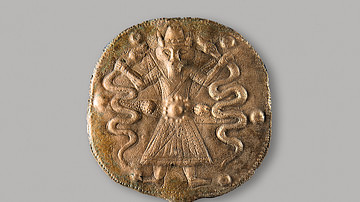
Bronze Hairpin Depicting 'Master of Animals' from Iron Age Zagros
Bronze Hairpin Depicting 'Master of Animals', found in Luristan (central Zagros), c. 950 to c. 650 BCE. National Museum of Iran, Tehran, acc. no. 1459. Photo by Neda Tehrani (Baloot Noghrei...
Image
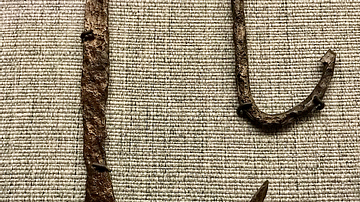
Viking Iron Fishing Hooks
The Vikings did not use fishing reels or poles. Instead, they tied hooks to a fishing line made from sheep, cow, or walrus intestines, then pulled the fish up by hand. On a small rowing boat out on the open ocean, this...

Image
Lumbini Ashokan Pillar
Brahmi inscription on an Ashokan Pillar (3rd century BCE) found at Lumbini in present-day Southern Nepal.

Image
Ashoka's pillar
Ashoka's pillar erected in the district of Vaishali, located in the Bihar state, India. This is one of the nineteen surviving columns erected or at least inscribed with edicts by the Emperor Ashoka during his reign in the 3rd...
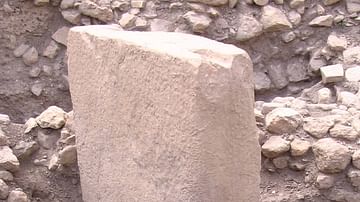
Image
Göbekli Tepe Pillar 27, Enclosure C, Layer III
Göbekli Tepe is a c. 12,000-year-old archaeological site in Anatolia, Turkey. The site chronology is divided into three levels, Layer I being the youngest and Layer III the oldest and deepest. Layer III...
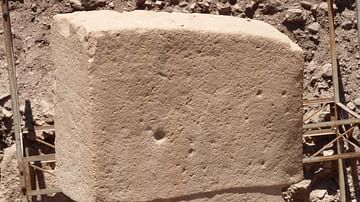
Image
Göbekli Tepe, Pillar with Sculpture of a Fox
Göbekli Tepe is a c. 12,000-year-old archaeological site in Anatolia, Turkey. One characteristic feature of the site is the abundance of monumental stone pillars, often arranged in a circle and elaborately...
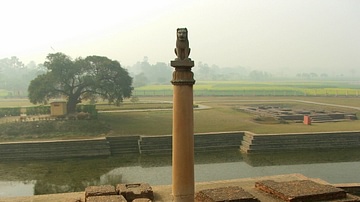
Image
Ashoka Pillar
Ashoka pillar at Vaishali, Bihar, India, 3rd century BCE.
