
Search
Remove Ads
Advertisement
Search Results

Definition
Bantu Migration
The Bantu migration from their origins in southern West Africa saw a gradual population movement sweep through the central, eastern, and southern parts of the continent starting in the mid-2nd millennium BCE and finally ending...
Image
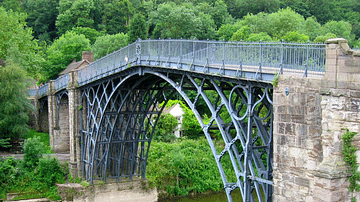
Shropshire Iron Bridge
The world's first cast iron bridge, built across the River Severn in Shropshire, England by Abraham Darby III (1750-89). It was completed in 1779 and opened to the public on New Year's Day, 1781. The design had to be a single-span...

Image
Mehrauli Pillar
Iron pillar in the Qutb complex near New Delhi, India from the Gupta period.

Image
View from Staircase of Central Pillar and Loculi, Columbarium 1, Vigna Codini
The loculi in the central pillar of this columbarium in Rome (discovered in 1940 CE) seem to have been reserved for the elected officers of the funeral institution (The name of...

Image
Iron Duke Locomotive
A working replica of the Iron Duke locomotive class of steam trains. designed for use on the Great Western Railway lines from the mid-19th century. (Great Western Society's Didcot Railway Centre)

Image
Iron Thorax Armour from Epirus
Iron anatomical thorax with golden buckles found in Cist grave 1 in Prodromi, Thesprotia, Epirus, Greece. The grave is dated to between the end of the 4th century BCE and the beginning of the 3rd century BCE. (Archaeological...

Image
Iron Peritrachelion (gorget) from Macedonian Tomb II of Vergina
Iron peritrachelion (gorget) with golden-silver decorative plate found in Macedonian Tomb II of Vergina, Imathia, Central Macedonia, Greece. The tomb is dated to between the end of the 4th...

Image
Gaya Iron Helmet
An iron helmet from the Gaya confederacy (42-532 CE), Korea. 5th-6th century CE. (National Museum of Korea, Seoul, South Korea)

Image
Iron Core of Linothorax with Golden Buckles
Iron core of linothorax with golden buckles found in Macedonian Tomb II of Vergina, Imathia, Central Macedonia, Greece. The tomb is dated to between the end of the 4th century BCE and the beginning of the...
Image
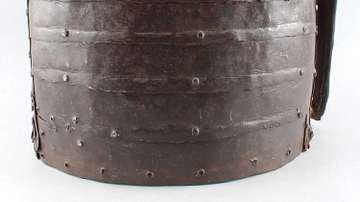
Iron Corslet from Borno
An iron corslet from Borno in what is now Fika, Nigeria. The corslet was acquired by the British Museum in 1911, and is currently a part of the museum's collection.
