
Search
Did you mean: Quran?
Remove Ads
Advertisement
Search Results

Article
Wine Culture in the Hellenistic Mediterranean
The culture of drinking wine was enjoyed throughout the Mediterranean world, and what is true now was true in antiquity, too: wine is always good business. The Hellenistic Period (c. 335-30 BCE), between...

Article
The Iraq Museum & Three Wars: Three Steps from Hell
This article documents and elaborates on the many critical behind-the-scenes events, unknown to the public, before the history leaves us. The author The bulk of the “the land between the two rivers”...

Interview
Interview: Peerless among Princes, the Life and Times of Sultan Süleyman by Kaya Şahin
Join World History Encyclopedia as they chat with Kaya Şahin about his new book Peerless among Princes, the Life and Times of Sultan Süleyman, published by Oxford University...

Definition
Mesopotamia - The Beginning of Beginnings
Mesopotamia (from the Greek, meaning "between two rivers") was an ancient region located in the Near East (Middle East) bounded in the northeast by the Zagros Mountains and in the southeast by the Arabian Plateau...

Image
Map of the Parthian (Arsacid) Empire, c. 150 CE - Iran’s Cavalry Empire Between Rome and the Silk Roads
The Parthian, or Arsacid, Empire (c. 247 BCE–224 CE) was an Iranian imperial state that emerged as Seleucid authority weakened in northeastern Iran. Arsaces...

Image
Battle of Karbala
A painting of the Battle of Karbala in 680 CE Iran. Iranian painting, oil on canvas, 19th century. From the Tropenmuseum, Amsterdam
Image
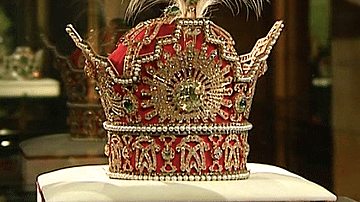
The Pahlavi Crown
The Pahlavi Crown, first worn by Reza Shah Pahlavi, Shah of Iran, at his coronation in April 1926. The design reminds of the rulers of the Sassanid dynasty (3rd-7th centuries CE). Made of gold and silver on a red velvet backing...

Image
Soviet Embassy, Tehran
A photograph of the Soviet embassy in Tehran, Iran. This was the location of the Tehran Conference in late 1943 when the leader of the USSR Joseph Stalin (1878-1953), President of the United States Franklin D. Roosevelt...
Image
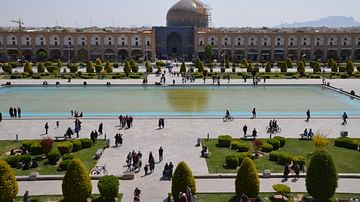
Naqsh-e Jahan Square, Isfahan
Naqsh-e Jahan Square is a public urban square situated at the centre of Isfahan in Iran. Constructed by Shah Abbas I the Great at the beginning of the 17th century CE, it is now an important historical site and one...

Image
Chogha Zanbil (Dur Untash)
Elamite Ziggurat located in today's Khuzestan Province in Iran. It was constructed in approximately 1250 BCE in a religious city originally called Dur Untash.
