
Search
Remove Ads
Advertisement
Search Results

Definition
Brahmi Script
The Brahmi script is the earliest writing system developed in India after the Indus script. It is one of the most influential writing systems; all modern Indian scripts and several hundred scripts found in Southeast and East Asia are derived...

Article
The Style & Regional Differences of Seljuk Minarets in Persia
Under the Seljuk rule, Persia gained a period of economic and cultural prosperity. The innovative techniques of the Seljuk period and style in architecture and the arts had a strong influence on later artistic developments. Seljuk art is...

Definition
Old Kingdom of Egypt
The Old Kingdom of Egypt (c. 2613-2181 BCE) is also known as the 'Age of the Pyramids' or 'Age of the Pyramid Builders' as it includes the great 4th Dynasty when King Sneferu perfected the art of pyramid building and the pyramids of Giza...

Definition
K'inich Janaab' Pakal
K'inich Janaab' Pakal (23 March 603 CE - 31 March 683 CE) was the Maya king of Palenque in the modern-day State of Chiapas, Mexico. Also known as Pacal (which means 'shield') and Pacal the Great, he is most famous for raising the city of...
Definition
Punt
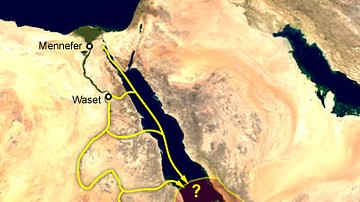
The Land of Punt was a region in Africa (most likely Somalia) referenced by inscriptions of ancient Egypt initially as a partner in trade and, later, as a semimythical country rich in resources and exotic goods. It is best known from the...

Definition
Oracle Bones
Oracle Bones (also known as Dragon's Bones) were the shoulder blades of oxen or plastrons of turtles (the flat underside of the turtle's shell) which were used in the Shang Dynasty of China (c. 1600-1046 BCE) for divination. The symbols carved...

Definition
New Kingdom of Egypt
The New Kingdom (c. 1570- c.1069 BCE) is the era in Egyptian history following the disunity of the Second Intermediate Period (c. 1782-1570 BCE) and preceding the dissolution of the central government at the start of the Third Intermediate...
Definition
Chandragupta II
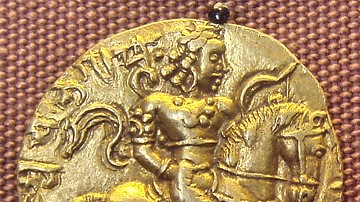
Chandragupta II (c. 375 CE - 413/14 CE) was the next great Gupta emperor after his father Samudragupta (335/350 - 370/380 CE). He proved to be an able ruler and conqueror with many achievements to his credit. He came to be known by his title...

Definition
Tukulti-Ninurta I
Tukulti-Ninurta I (reigned 1244-1208 BCE) was a king of the Assyrian Empire during the period known as the Middle Empire. He was the son of Shalmaneser I (reigned 1274-1245 BCE) who had completed the work of his father, Adad Nirari I, in...
Article
A Linguistical Analysis of Ancient Celtic Languages
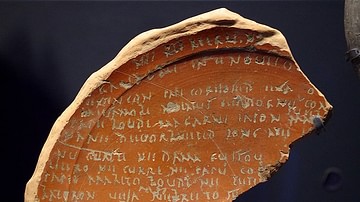
The Celtic languages form a branch of the Indo-European (IE) language family. They derive from Proto-Celtic and are divided into Continental Celtic languages (Lepontic, Gaulish, Galatian, Noric, Celtiberian, Gallaecian) and Insular Celtic...
