
Search
Remove Ads
Advertisement
Search Results

Article
Views of the Afterlife in Roman Tombstone Inscriptions
Ancient views of the afterlife are reflected in literature, tomb inscriptions, and grave goods. Then, as now, a belief in another stage of existence after death was a shared belief by all ancient societies. Initially, the Greco-Roman Hades...

Article
The Ancient Celtic Pantheon
The ancient Celtic pantheon consisted of over 400 gods and goddesses who represented everything from rivers to warfare. With perhaps the exception of Lugh, the Celtic gods were not universally worshipped across Iron Age Europe but were very...

Article
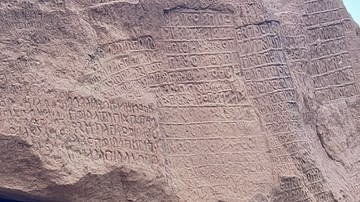
Libyan' Inscriptions in Numidia and Mauretania
When the Numidian king Massinissa (c.241-148) died, the people of Dougga (or: Thugga) decided to build a monument in his honour. A bilingual inscription (RIL 2, KAI 101) says the building was erected in the tenth reign year of his successor...
Image
Inscriptions at Jabal Ikmah
Jabal Ikmah, often referred to as an ‘open-air library’, contains hundreds of inscriptions engraved and carved in relief on the rock faces and boulders of a gorge, not far from Dadan, the seat of the Dadanite and Lihhyanite kingdoms, Saudi...

Image
Inscriptions and Petroglyphs at Jabal Ikmah
Jabal Ikmah, often referred to as an ‘open-air library’, contains hundreds of inscriptions and pictograms engraved and carved in relief on the rock faces and boulders of a gorge, not far from Dadan, the seat of the Dadanite and Lihhyanite...
Image
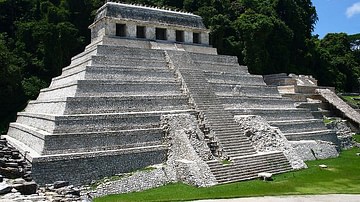
Temple of the Inscriptions, Palenque
The Temple of the Inscriptions at Palenque, Mexico. The pyramid was completed c. 682 CE and used as the tomb of the Maya king Kinich Janaab Pacal (r. 615-683 CE).
Image
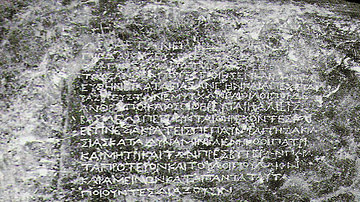
Greek and Aramaic inscriptions by king Ashoka
Bilingual (Greek and Aramaic) inscriptions by king Ashoka at Kandahar (Shar-i-kuna). (3rd century BCE). Preserved at Kabul Museum. Today disappeared. Two-dimensional inscription. Greek (transliteration) 1. δέκα ἐτῶν πληρηεὺς...
Image
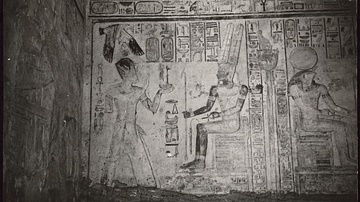
Bas-Relief Inscriptions at Abu Simbel Great Temple
Great Temple (height: 110 feet / 33 meters, width: 127 feet / 38 meters) built under the 19th dynasty. On the facade, four colossuses about 67 feet / 20 meters high represent Rameses II (1290-1223 BCE). The complete work is 270 feet / 68...
Image
Japanese Tablet with Sutra Inscriptions
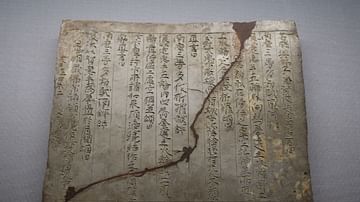
This clay tablet with sutra inscriptions was excavated at Komachizuka Sutra Mound in Tanga, which is located in Mie prefecture, Japan. It dates to 1174 CE (Jo'an 4). Important cultural property. (Tokyo National Museum)
Image
Tablets with King Nabonidus Inscriptions, Harran
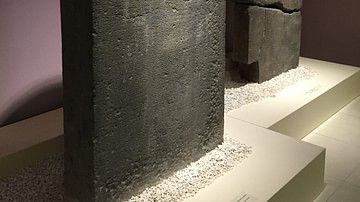
These large tablets comes from the 6th-5th century BCE. They contain the inscriptions from King Nabonidus, who was the last king of the Neo-Babylonian Empire, reigning from 556–539 BC. These tablets were found in Harran - near Sanliurfa...
