
Search
Remove Ads
Advertisement
Search Results

Definition
New Model Army
The New Model Army was created in February 1645 by the Parliamentarians during the English Civil Wars (1642-1651) that turned England from a monarchy to a republic. It was a professional army in terms of its personnel, training...

Article
Battle of Edgehill
The Battle of Edgehill in Warwickshire on 23 October 1642 was an early engagement in the English Civil Wars (1642-1651) and the first major battle of that conflict. The Royalist forces loyal to Charles I of England (r. 1625-1649...
Article
Battle of Sobraon
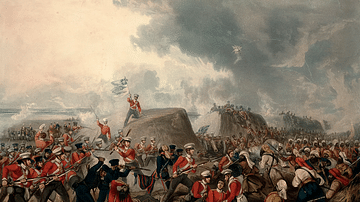
The Battle of Sobraon on 10 February 1846 was the last of four major victories for the British East India Company (EIC) against the Sikh Empire during the First Anglo-Sikh War (1845-6). Lieutenant-General Sir Hugh Gough (1779-1869...

Definition
Sepoy
A sepoy was an Indian soldier in the armies of various states and European trading companies in the Indian subcontinent and then, from the second half of the 19th century, in the British Indian Army. Recruited from many different population...

Definition
Roman Cavalry
Cavalry, although never replacing infantry as the mainstay of the Roman army, could provide useful cover on the flanks of armies, could be used as a shock tactic to cause disruption to enemy infantry formations, and could pursue...

Definition
Carthaginian Army
The armies of Carthage permitted the city to forge the most powerful empire in the western Mediterranean from the 6th to 3rd centuries BCE. Although by tradition a seafaring nation with a powerful navy, Carthage, by necessity...

Definition
Gold Beach
Gold Beach was the central of the five Allied D-Day Normandy landings of 6 June 1944. Primarily British units, with massive naval and air support, were set the task of taking the beach, a feat achieved by the end of the day, using...

Article
The Red Army in WWII
The Red Army of the USSR began the Second World War (1939-45) with a series of shocking defeats, but from late 1942, it rallied and held on to key cities like the capital Moscow, Leningrad (Saint Petersburg), and Stalingrad...

Article
The Armies of the Crusades
The armies of the Crusades (11th-15th centuries CE), which saw Christians and Muslims struggle for control of territories in the Middle East and elsewhere, could involve over 100,000 men on either side who came from all...

Article
Battle of Hydaspes
For almost a decade, Alexander the Great and his army swept across Western Asia and into Egypt, defeating King Darius III and the Persians at the battles of River Granicus, Issus and Gaugamela. Next, despite the objections of...
