
Search
Remove Ads
Advertisement
Search Results

Definition
Christopher Columbus
Christopher Columbus (l. 1451-1506 CE, also known as Cristoffa Corombo in Ligurian and Cristoforo Colombo in Italian) was a Genoese explorer (identified as Italian) who became famous in his own time as the man who discovered...

Image
European Depiction of a Victorious Saladin
A romanticized portrait of Saladin, by Gustav Dore (made in the 19th century).

Image
Moon Idol from Central European Bronze Age
Clay figurine found in Chorvátsky Grob, Late Bronze Age. Slovak National Museum, Bratislava. Moon idols (Mondidole), also known as 'firedogs' (Feuerböcke), were clay figurines shaped like a dog or wolf...

Article
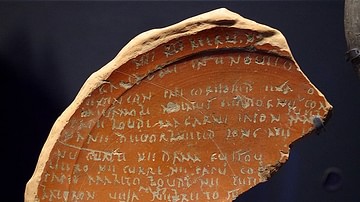
The Phoenician Alphabet & Language
Phoenician is a Canaanite language closely related to Hebrew. Very little is known about the Canaanite language, except what can be gathered from the El-Amarna letters written by Canaanite kings to Pharaohs Amenhopis...
Article
A Linguistical Analysis of Ancient Celtic Languages
The Celtic languages form a branch of the Indo-European (IE) language family. They derive from Proto-Celtic and are divided into Continental Celtic languages (Lepontic, Gaulish, Galatian, Noric, Celtiberian...

Definition
Taxila
When it comes to ancient history, Pakistan contains its fair share of treasures, one of the prominent of these being the ancient metropolis of Taxila. It is a city of the Gandharan civilization, sometimes known as one of its capitals...

Definition
Romani
Romani is an umbrella term used to describe a diverse ethnolinguistic group of people with a historical presence in Europe and West Asia. The historically common term 'Gypsy' is based on the myth that they came from Egypt. In reality...

Definition
Columbian Exchange
The Columbian exchange is a term coined by Alfred Crosby Jr. in 1972 that is traditionally defined as the transfer of plants, animals, and diseases between the Old World of Europe and Africa and the New World of the Americas...

Definition
Monroe Doctrine - The Controversial Cornerstone of US Foreign Policy
The Monroe Doctrine, a significant piece of United States foreign policy, was first articulated by President James Monroe in 1823, and it essentially warns the powers of Europe from meddling...

Video
Expansion & Consequences: Crash Course European History #5
European exploration had a lot of side effects. When the Old World and the New World began to interact, people, wealth, food, animals, and disease began to flow in both directions. In the New...
