
Search
Remove Ads
Advertisement
Search Results

Article
Ten Great Native American Mound Sites
The Native Americans of Pre-Colonial North America built thousands of mounds across the continent which served various purposes and sometimes reached heights over 100 feet. Many of the mound sites were thriving...

Definition
Parthian Religion
Parthian religion might be best described with two words: inclusive and evolving. As Parthia's empire held within it a variety of cultures, the Parthians wisely left each to their own beliefs and traditions, like the Seleucid...

Definition
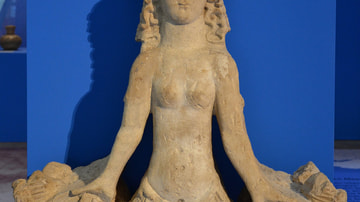
Frigg
Frigg is a fertility goddess in Norse mythology. She is the wife of Odin, king of the gods, and is the greatest goddess of the Norse pantheon. She is thought to have developed, along with the goddess Freyja, from an earlier fertility...
Definition
Scythian Religion
Scythian religion appears to be an amalgam of belief in a pantheon of gods grafted to more ancient animal reverence and shamanistic practice. According to their burial finds, the Scythians appear to have had a deep affinity with...

Definition
Flour War
The Flour War refers to the series of approximately 300 riots that swept through France from April to May 1775, because of rising bread prices. The revolts only subsided after soldiers had been deployed, resulting in hundreds of arrests...

Definition
Khmer Empire
The Khmer empire was a powerful state in South East Asia, formed by people of the same name, lasting from 802 CE to 1431 CE. At its peak, the empire covered much of what today is Cambodia, Thailand, Laos, and southern Vietnam. By...

Definition
Pharaoh
The Pharaoh in ancient Egypt was the political and religious leader of the people and held the titles 'Lord of the Two Lands' and 'High Priest of Every Temple'. The word 'pharaoh' is the Greek form of the Egyptian pero or per-a-a, which...
Definition
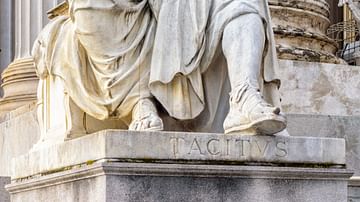
Tacitus
Publius Cornelius Tacitus (l. c. 56 - c. 118 CE) was a Roman historian, active throughout the reign of Trajan (r. 98-117 CE) and the early years of Hadrian (r. 117-138 CE). His best-known works are Histories and Annals, which cover the...

Definition
Berbers
The Berbers have occupied North Africa, specifically the Maghreb, since the beginning of recorded history and until the Islamic conquests of the 8th century CE constituted the dominant ethnic group in the Saharan region. Modern Berber...

Definition
Battle of Jemappes
The Battle of Jemappes was a decisive battle in the War of the First Coalition (1792-97), part of the French Revolutionary Wars (1792-1802). On 6 November 1792, a French army under General Charles-François Dumouriez defeated...
