
Search
Remove Ads
Advertisement
Search Results

Article
Spiritual Defense - Execration Rituals in Ancient Egypt
Magic was an integral aspect of life in ancient Egypt. The world was created through the power of heka (magic) as Atum stood on the primordial mound of the ben-ben in the middle of the endless waters...

Article
Angels in Ancient Judaism
The concept and function of angels in ancient Judaism were some of the many elements incorporated from contemporary cultures and religious views. The Hebrew malakh was translated into the Greek angelos, both of which indicated...
Article
The Debate Between Sheep and Grain
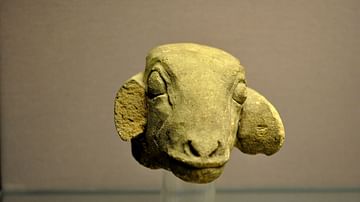
The Debate Between Sheep and Grain (c. 2000 BCE) is one of the best-known Sumerian literary debates in a genre that was popular entertainment by the late 3rd millennium BCE. In this piece, personifications of grain...
Article
The Satire of the Trades
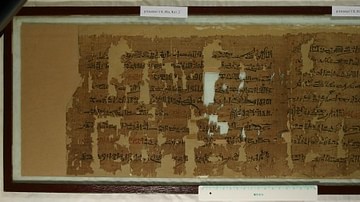
The literature of ancient Egypt is as rich and varied as any other culture. From the inscriptions of the Old Kingdom of Egypt (c. 2613-2181 BCE) through the Love Poems of the New Kingdom (c. 1570 - c. 1069 BCE) the Egyptian...
Article
Ancient Egyptian Medicine: Study & Practice
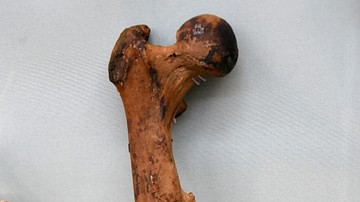
In Europe, in the 19th century CE, an interesting device began appearing in graveyards and cemeteries: the mortsafe. This was an iron cage erected over a grave to keep the body of the deceased safe from 'resurrectionists'...

Image
Clay Mask from the Old Babylonian Era
A clay mask depicting a face with acting expressions. Mesopotamian art usually portrays human faces in a poker-like configuration. This one has 3 small holes at the upper part which might have been used to attach...
Image
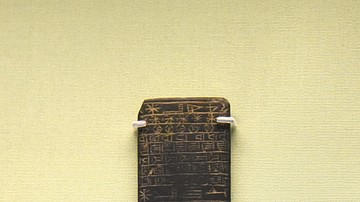
Mesopotamian Amulet Against Ghosts
Stone inscribed with an incantation that has 7 signs, repeated 7 times. It is much worn through use. From Mesopotamia, modern-day Iraq, c. 800-550 BCE.
The British Museum, London.
