
Search
Remove Ads
Advertisement
Search Results

Image
Imperial Chinese Examination Hall
An examination hall in Suzhou where candidates sat for the civil service examinations which were conducted throughout the history of imperial China. Painted scroll by Xiu Yang, 18th century CE. (Liaoning Provincial...

Image
Organization of the Imperial Roman Army
The Imperial Roman Army formed the backbone of Roman power from the establishment of the Principate under Augustus (reign 27 BCE–14 CE) to the collapse of imperial authority in the West (c. 480 CE). More than...

Image
Map of the Hadrian’s First Imperial Tour, 121–125 CE - Frontier Inspection, Hadrian’s Wall and Provincial Rule
Hadrian’s first great imperial tour (121–125 CE) transformed travel into an instrument of government across the Roman Empire. Leaving Rome in 121 CE, Hadrian...

Video
The Lives of Women in Ancient China
In Ancient China, it was widely known that it was better to be born a male than a female. To be born a female meant being subordinate to one’s father, then to one’s husband and if a wife became a widow, then she...

Definition
Khitan
The Khitan people formed the Liao dynasty and ruled parts of Mongolia, Manchuria, and northern China from 907 to 1125 CE. Adopting elements of Chinese government and culture, the Khitan were more than a match for their rivals the Song...
Image
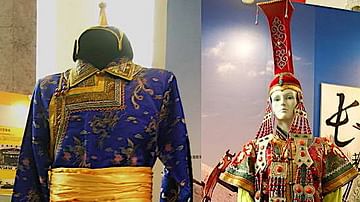
Mongol Clothing of the Imperial Court
Examples of male and female clothing worn by Mongols at the imperial Yuan Dynasty court in the 13th and 14th century CE. (Intangible Cultural Heritage Exhibition, National Museum of China, Beijing)

Definition
Genghis Khan
Genghis Khan (aka Chinggis Khan) was the founder of the Mongol Empire which he ruled from 1206 until his death in 1227. Born Temujin, he acquired the title of Genghis Khan, likely meaning 'universal ruler’, after unifying the Mongol...

Article
The Seven Voyages of Zheng He
Admiral Zheng He (aka Cheng Ho, c. 1371-1433 CE) was a Chinese Muslim eunuch explorer who was sent by the Ming dynasty emperor Yongle (r. 1403-1424 CE) on seven diplomatic missions to increase trade and secure tribute...

Definition
Edo Period
The Edo period refers to the years from 1603 until 1868 when the Tokugawa family ruled Japan. The era is named after the city of Edo, modern-day Tokyo, where the Tokugawa shogunate had its government. It is also sometimes referred...

Image
The Julio-Claudian Dynasty, The Rise of Imperial Rome - From Augustus to Nero - Rome's First Imperial Family
The Julio-Claudian dynasty (27 BCE–68 CE) oversaw the establishment and consolidation of the Roman Empire following the political crises and civil wars that...
