
Search
Search Results

Article
Follow the Money. The Coinage of Later Imperial Rome: A Reflection of Economic Stress and Decline
Unlike the practice of professional numismatists, I prefer to see the “big picture”. So, my entire Roman coin collection, all 250 pieces, from Julius Caesar to Valentinian III is laid out on a single pane of glass in a cabinet, in chronological...
Image
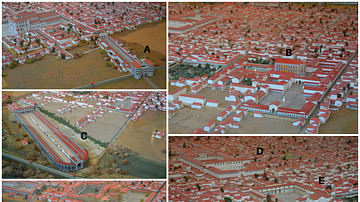
Scale Model of Augusta Treverorum (Trier)
Scale model of Augusta Treverorum in the Rheinisches Landesmuseum in Trier. A) Porta Nigra; B) Basilica of Constantine; C) Circus; D) Forum; E) Imperial Baths; F) Roman Bridge across the Moselle River

Article
Death's Mansions: The Columbaria of Imperial Rome
A columbarium is an underground chamber, which the Romans used for preserving the ashes of the dead. During the 1st and 2nd centuries CE, hundreds of columbaria lined the consular highways leading out of Rome, although now only some two dozen...
Image
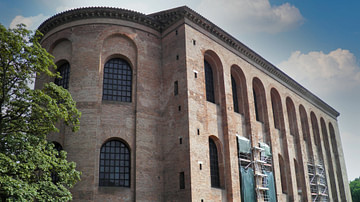
Basilica of Constantine, Trier
The Basilica of Constantine (Aula Palatina) in Trier (Germany) was built around 310 CE by Constantine I (r. 306-337 CE) as the reception and throne room of the imperial palace . With an interior 67 metres (219 ft) long and 33 metres (108...
Image
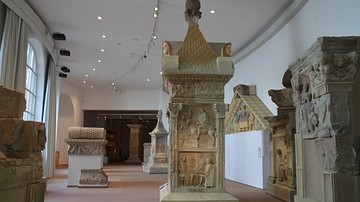
Rheinisches Landesmuseum Trier
The Rheinisches Landesmuseum is Trier's largest and best-known museum. It offers a comprehensive collection documenting the civilisation, economy, settlements, religion and art of the first four centuries CE, emphasising the Roman past of...
Image
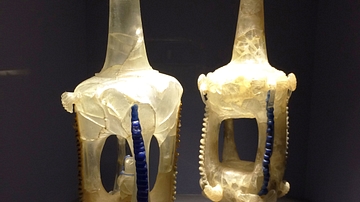
Bottles with Four Tubes from Roman Cologne and Trier
Four tubes are connected to the upper and lower portions of these ancient Roman glass bottles. The tubes were created by carefully cutting and bending the body of a free-blown glass bottle. Like similar piece from Trier, the Cologne bottle...
Image
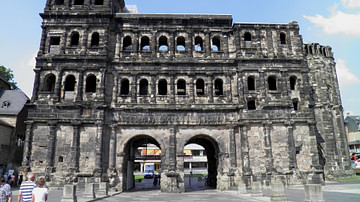
Porta Nigra, Trier
The Porta Nigra in Trier (Germany) is the best-preserved Roman city gate north of the Alps. Constructed in grey sandstone around 170 CE, it guarded the northern entry to the Roman town of Augusta Treverorum. While the other three city gates...
Image
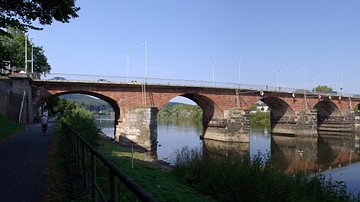
Roman Bridge, Trier
Spanning the Moselle River, the Roman bridge (German: Römerbrücke) in Trier is Germany's oldest standing bridge. It was built in 144 CE from black basalt from the Eifel mountains but its superstructure, now made of stone, was once made of...
Image
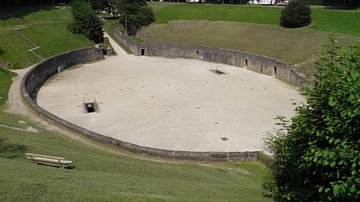
Trier Amphitheatre
The Trier amphitheatre was built towards the end of the 2nd century CE, and is part of the UNESCO World Heritage Site. It is estimated that it once held up to 18,000 spectators for gladiator tournaments and animal fights. The arena measured...

Article
Roman Daily Life
From the early days of the Roman Republic through the volatile reigns of such ignoble emperors as Caligula, Nero, and Commodus, the Roman Empire continued to expand, stretching its borders to encompass the entire Mediterranean Sea as well...
