
Search
Remove Ads
Advertisement
Search Results

Definition
Chinese Writing
Ancient Chinese writing evolved from the practice of divination during the Shang Dynasty (1600-1046 BCE). Some theories suggest that images and markings on pottery shards found at Ban Po Village are evidence of an early writing...

Definition
Sun-Tzu
Sun Tzu (l. c. 500 BCE) was a Chinese military strategist and general best known as the author of the work The Art of War, a treatise on military strategy (also known as The Thirteen Chapters). He was associated (formally or as an inspiration...

Definition
Confucianism
Confucianism is a philosophy developed in 6th-century BCE China, which is considered by some a secular-humanist belief system, by some a religion, and by others a social code. The broad range of subjects touched on by Confucianism...

Definition
Queen Himiko
Queen Himiko, also known as Pimiko or Pimiku (183? - 248 CE), was a 3rd-century CE ruler of the territory in ancient Japan known as Hsieh-ma-t'ai or Yamatai, later to be known as Yamato. Considered by the Chinese as the ruler of...

Definition
Sima Qian
Sima Qian (l. 145/135-86 BCE) was a court scribe, astrologer, and historian of the Han Dynasty (202 BCE - 220 CE) of ancient China, famous for his historical work Records of the Grand Historian for which he is remembered as the Father...

Definition
Chinese Literature
Chinese literature is among the most imaginative and interesting in the world. The precision of the language results in perfectly realized images whether in poetry or prose and, as with all great literature, the themes are timeless...

Definition
Mencius
Mencius (l. 372-289 BCE, also known as Mang-Tze or Mang-Tzu) was a Confucian philosopher during The Warring States Period in China (c. 481-221 BCE) and is considered the greatest after Confucius himself for his interpretation, formulation...

Definition
Xunzi
Xunzi (pronounced shund-zee, l. c. 310-c. 235 BCE) was a Confucian philosopher of the Warring States Period (c. 481-221 BCE) in China. He is also known as Hun Kuang, Hsun Tzu, Xun Tzu, and Xun Kuang. Xunzi translates as Master Xun and...
Definition
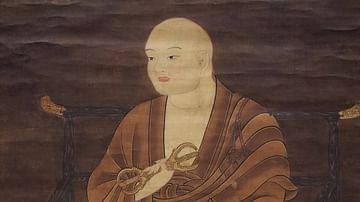
Kukai - Japan's Founder of Shingon Buddhism
Kukai or Kobo Daishi (774-835 CE) was a scholar, poet, and monk who founded Shingon Buddhism in Japan. The monk became the country's most important Buddhist saint and has been credited with all manner of minor...

Definition
Teng Shih
Teng Shih (l. c. 500 BCE) was a Chinese Sophist and lawyer who lived and wrote in the province of Cheng (Pengcheng, modern-day Xuzhou, Jiangsu province) during the era of the Spring and Autumn Period (c. 772-476 BCE) which preceded...
